
Identifying Risk Factors and Spatial Clustering of HIV Infection Among Female Sex Workers in India
DOI:
https://doi.org/10.21106/ijtmrph.145Keywords:
- Female Sex Worker,
- Kriged Map,
- Factor Analysis,
- Principle Component Analysis,
- HIV,
- Sexually Transmitted Infections
Abstract
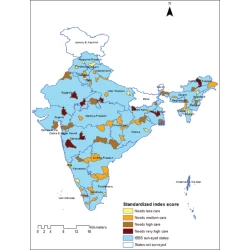
Background: The human immunodeficiency virus (HIV) epidemic in India is generally considered to be more concentrated, with the focus on high-risk groups including female sex workers (FSWs). The Integrated Biological and Behavioral Surveillance (IBBS), the first nationwide surveillance conducted during 2014-2015, collected many key indicators, including indicators related to HIV/STI transmission. The purpose of this study was to develop an index score for each domain surveyed and to identify focus areas for interventions among FSWs. Methods: The study population consisted of 27,007 FSWs. Forty high-risk related covariates of HIV/STI transmission, demographic characteristics, sexual history, condom practices, knowledge of HIV/STI and biological variables were considered. The original data set was examined using the correlation matrix and was reduced to 15 highly-correlated factors using principal component analysis. The factors were further improved using varimax rotation and the percentage of variation was used as weights to obtain the initial score for each domain, which were then standardized for comparison. Bartlett’s test of sphericity was examined before the factor extraction. Results: Six factors were extracted, which together explained about 73% of the total variation. The factors were: (1) more number of clients; (2) younger FSW and started selling sex at younger age; (3) experiencing condom breakage; (4) having occasional clients and poor HIV/AIDS knowledge; (5) illiteracy; and (6) a longer period of sex work. Six domains with an index score of above 80, from the states of Maharashtra, Rajasthan, Arunachal Pradesh, Uttar Pradesh, and Jharkhand need greater intervention. Conclusion and Implications for Translation: FSWs’ current age, age at commencement of sex work, and the number of clients were the indicators most-associated with HIV infection. Therefore, program and policy interventions should focus on FSWs who are younger than 10 clients.
Downloads
Similar Articles
- Gopal K Singh, Shanita D Williams, Hyunjung Lee, Elijah K Martin, Michelle Allender, Christine T Ramey, Trends in Physical and Mental Health, Mortality, Life Expectancy, and Social Inequalities Among American Indians and Alaska Natives, 1990-2019 , Vol. 5 No. 2 (2021): The International Journal of Translational Medical Research and Public Health (IJTMRPH)
- Selina Khatun, Rafiqul Islam, Nazrul Islam Mondal, Nazrul Hoque, Clyde McNeil, Fatema Siddiqua, Sociodemographic Determinants of Early, Normal, and Delayed Menarche among Female College-Aged Students in Bangladesh , Vol. 1 No. 1 (2017): The International Journal of Translational Medical Research and Public Health (IJTMRPH)
- Mariam Amer Al-Tell, Khulud Mansor, Stress Coping Strategies Among Secondary School-Aged Students in Government Schools in Northern West Bank/Palestine , Vol. 3 No. 1 (2019): The International Journal of Translational Medical Research and Public Health (IJTMRPH)
- Japhet Adeniran Olugbogi, Saheed Akinmayowa Lawal, Oluwaseyi Senapon Babatunde, Evaluation of Access, Satisfaction and Perceived Quality of a Free Community Medical Outreach in Badagry, Lagos, Southwest Nigeria , Vol. 10 (2026): The International Journal of Translational Medical Research and Public Health (IJTMRPH)
- Uksim Qadri, Bashir Ahmad Fomda, Saleem Javaid Wani, Shugufta Roohi, Sanam Rasool Wani, Hepatitis A and E: Prevalence, Epidemiology and Co-infection among Patients with Acute Viral Hepatitis , Vol. 9 No. Continuous (2025): The International Journal of Translational Medical Research and Public Health (IJTMRPH)
- semvua kilonzo, Hyasinta Jaka, Sylvanus Mapunda, Knowledge and Risk Assessment of Hepatitis B Infection among Barbers and Beauty Salon Workers in Mwanza, Tanzania , Vol. 8 No. Continuous (2024): The International Journal of Translational Medical Research and Public Health (IJTMRPH)
- Fazal Dad, Tafara Ndumiyana, Aweke Kebede, Blessing Butaumocho, Anthony Muganza, Robert Ackatia Armah, Lidya Mitike, Mella Taban, Strengthening Rural Food Systems through the UN World Food Program’s Fresh Food Voucher in Ethiopia’s Somali Region: An Evaluation of Nutritional and Market Impacts , Vol. 10 (2026): The International Journal of Translational Medical Research and Public Health (IJTMRPH)
- Lucrèce M Delicat-Loembet, A.D. Nno Mabiala, Ulrich Bisvigou, Eveline Avoune, Solange Bongo, André N’Tchoreret, Arnaud Kouoyo, Alain Ondo, Alexis E Dokekias, Jean Koko, Simon Ategbo, Diagnosis of Sickle Cell Disease in Gabon Using Sickle SCAN®: A Point-of-Care Blood Test , Vol. 6 No. 2 (2022): The International Journal of Translational Medical Research and Public Health (IJTMRPH)
- Gordon Amadi, Samuel C Iwuji, Taofik O Azeez, Chidozie J Nwaokoro, Chioma O Wodu, Biochemical Effects of Piper Guineense (African Black Pepper) in Female Diabetics: Opportunities for Diabetes Treatment , Vol. 3 No. 1 (2019): The International Journal of Translational Medical Research and Public Health (IJTMRPH)
- Ernest Mutua, Okello B.M Agina, Isaac J Mwanzo, Prevalence and Correlates of Medication Non-adherence among Hypertensive Patients on Follow-up in Central Kenya , Vol. 7 No. 1 (2023): The International Journal of Translational Medical Research and Public Health (IJTMRPH)
<< < 1 2 3 4 5 6 7 8 9 10 > >>
You may also start an advanced similarity search for this article.
Published
How to Cite
Issue
Section
License
Copyright © 2021 Arumugam Elangovan, Vasna Joshua, Aridoss Santhakumar, Balasubramanian Ganesh, Nagaraj Jaganathasamy, Joseph K David, Malathi Mathiyazhakan, Manikandan Natesan, VM Padmapriya, Pradeep Kumar. Published by Global Health and Education Projects, Inc., USA.

This is an open-access article distributed under the terms of the Creative Commons Attribution-NonCommercial-ShareAlike 4.0 International License , which permits others to remix, transform, and build upon the work non-commercially, provided the original author is credited and the new creations are licensed under the same terms.



 .
.

