
Identifying Risk Factors and Spatial Clustering of HIV Infection Among Female Sex Workers in India
DOI:
https://doi.org/10.21106/ijtmrph.145Keywords:
- Female Sex Worker,
- Kriged Map,
- Factor Analysis,
- Principle Component Analysis,
- HIV,
- Sexually Transmitted Infections
Abstract
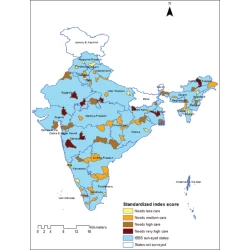
Background: The human immunodeficiency virus (HIV) epidemic in India is generally considered to be more concentrated, with the focus on high-risk groups including female sex workers (FSWs). The Integrated Biological and Behavioral Surveillance (IBBS), the first nationwide surveillance conducted during 2014-2015, collected many key indicators, including indicators related to HIV/STI transmission. The purpose of this study was to develop an index score for each domain surveyed and to identify focus areas for interventions among FSWs. Methods: The study population consisted of 27,007 FSWs. Forty high-risk related covariates of HIV/STI transmission, demographic characteristics, sexual history, condom practices, knowledge of HIV/STI and biological variables were considered. The original data set was examined using the correlation matrix and was reduced to 15 highly-correlated factors using principal component analysis. The factors were further improved using varimax rotation and the percentage of variation was used as weights to obtain the initial score for each domain, which were then standardized for comparison. Bartlett’s test of sphericity was examined before the factor extraction. Results: Six factors were extracted, which together explained about 73% of the total variation. The factors were: (1) more number of clients; (2) younger FSW and started selling sex at younger age; (3) experiencing condom breakage; (4) having occasional clients and poor HIV/AIDS knowledge; (5) illiteracy; and (6) a longer period of sex work. Six domains with an index score of above 80, from the states of Maharashtra, Rajasthan, Arunachal Pradesh, Uttar Pradesh, and Jharkhand need greater intervention. Conclusion and Implications for Translation: FSWs’ current age, age at commencement of sex work, and the number of clients were the indicators most-associated with HIV infection. Therefore, program and policy interventions should focus on FSWs who are younger than 10 clients.
Downloads
Similar Articles
- Chongo Clays Siwale, Seter Siziya, Factors Associated with Alcohol Consumption Among Students in High-Cost Schools in Lusaka, Zambia , Vol. 3 No. 1 (2019): The International Journal of Translational Medical Research and Public Health (IJTMRPH)
- Gopal K. Singh, Hyunjung Lee, Romuladus E. Azuine, Trends and Socioeconomic, Demographic, and Behavioral Determinants of Kidney Disease Prevalence among African Americans in the United States, 1997–2021 , Vol. 9 No. Continuous (2025): The International Journal of Translational Medical Research and Public Health (IJTMRPH)
- Amina P Alio, Linxi Liu, Kelly Thevenet-Morrison, Michelle R Rubado, Hugh F Crean, Peter J Veazie, Christopher L Seplaki, Ann Dozier, Association of Voluntary Legal Paternity and Breastfeeding Duration and Exclusivity in a Sample of Mothers in NewYork State, United States , Vol. 5 No. 2 (2021): The International Journal of Translational Medical Research and Public Health (IJTMRPH)
- Chinyelu O Mba, Ransom B Jacob, Mercy B Green, Loveday U Zebedee, Hematological Profile of Pregnant Women in Port Harcourt, Nigeria , Vol. 3 No. 1 (2019): The International Journal of Translational Medical Research and Public Health (IJTMRPH)
- Anushka Banerjee, Abhijit G. Banerjee, Chronic Inflammation in Polycystic Ovarian Syndrome: Examining Biomarker–Driven Control Strategies to Reduce Population–Level Disease Burden , Vol. 8 No. Continuous (2024): The International Journal of Translational Medical Research and Public Health (IJTMRPH)
- Elijah K Martin, Lea Jacobson, Gopal K Singh, Payam Sheikhatari, Mehrete Girmay, Smoking-Free Policies and Smoking Behaviors among Historically Black Colleges and Universities Students in the United States , Vol. 4 No. 2 (2020): The International Journal of Translational Medical Research and Public Health (IJTMRPH)
- Mehrete Girmay, Gopal K Singh, Social Isolation, Loneliness, and Mental and Emotional Well-being among International Students in the United States , Vol. 3 No. 2 (2019): The International Journal of Translational Medical Research and Public Health (IJTMRPH)
- Gopal K Singh, Hyunjung Lee, Romuladus E Azuine, Increasing Trends in Physical and Mental Health Problems among US Workers in Different Job Sectors During the COVID-19 Pandemic , Vol. 5 No. 2 (2021): The International Journal of Translational Medical Research and Public Health (IJTMRPH)
- Hyunjung Lee, Gopal K Singh, Marked Disparities in Cardiovascular Disease Mortality by Levels of Happiness and Life Satisfaction in the United States , Vol. 4 No. 2 (2020): The International Journal of Translational Medical Research and Public Health (IJTMRPH)
- Bashir Faiza, Hassan Mehmood, Sumera Naz, Saima Naz, Prevalence and Determinants of Substance Abuse Among Slum Dwellers in Islamabad- Pakistan , Vol. 3 No. 2 (2019): The International Journal of Translational Medical Research and Public Health (IJTMRPH)
<< < 5 6 7 8 9 10 11 12 13 14 > >>
You may also start an advanced similarity search for this article.
Published
How to Cite
Issue
Section
License
Copyright © 2021 Arumugam Elangovan, Vasna Joshua, Aridoss Santhakumar, Balasubramanian Ganesh, Nagaraj Jaganathasamy, Joseph K David, Malathi Mathiyazhakan, Manikandan Natesan, VM Padmapriya, Pradeep Kumar. Published by Global Health and Education Projects, Inc., USA.

This is an open-access article distributed under the terms of the Creative Commons Attribution-NonCommercial-ShareAlike 4.0 International License , which permits others to remix, transform, and build upon the work non-commercially, provided the original author is credited and the new creations are licensed under the same terms.



 .
.

