
Diagnosis of Sickle Cell Disease in Gabon Using Sickle SCAN®: A Point-of-Care Blood Test
DOI:
https://doi.org/10.21106/ijtmrph.315Keywords:
- Sickle Cell Disease,
- Phenotypic Diagnosis,
- Sickle SCAN®,
- Capillary Electrophoresis,
- Gabon
Abstract
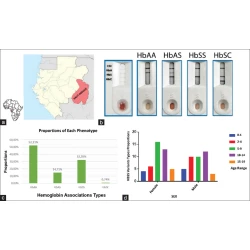
Background: Sickle cell disease (SCD) is the world’s most common genetic blood disorder. Most infant deaths from SCD occur in sub-Saharan Africa, and the mortality rate is exceptionally high in Gabon in Central Africa. In Gabon, there are limited resources for early and accurate detection of sickle cell or trait conditions. Most affected individuals reside in low-resource areas where access to diagnostic testing is often very limited. The most commonly used diagnostic methods require trained staff, adequate infrastructure, electric power, and enough time to perform the analysis. These requirements do not currently allow mass screening to be performed in remote areas of Gabon. The purpose of this pilot study is to develop a standardized screening procedure for SCD in order to determine its prevalence in the southeast area of Gabon by using a rapid and reliable test that does not require significant resources, such as the Sickle SCAN® device. Methods: The accuracy of the Sickle SCAN® device was assessed based on testing 272 blood samples. The exact hemoglobin was identified in 100% of the samples. The test comprises three proprietary indicators that detect the presence of hemoglobin A, S, and C, thus allowing the user to rapidly distinguish between normal (HbAA, N=142), carrier (HbAS, N=41), and sickle cell disease (HbSS, N=88; HbSC, N=1) samples. Hemoglobin variants (S and C) were confirmed by capillary electrophoresis (MinicapR; Sebia). The sensitivity and specificity were calculated for each phenotype. Results: The Sickle SCAN® test analysis revealed the following normal and abnormal phenotypes, including sickle cell trait (HbAS=14,71%) and SCD [HbSS (32.35%) and HbSC (0,74)]. There are no false positives in Sickle SCAN® result for the presence of hemoglobin variant, compared to gold standard approaches to capillary electrophoresis. The estimated sensitivity of the Sickle Scan® test was 92.2%, 100%, and 100% for HbSS, HbAS, and HbSC, respectively. The specificity exceeded 88.23% for all phenotypes (HbSS, HbAS, and HbSC). Conclusion and Implications for Translation:The Sickle Scan® device was found to be reliable with a sensitivity of 92.2%, 100%, and 100% for HbSS, HbAS, and HbSC, respectively. The specificity exceeded 88% for all phenotypes.
Downloads
Similar Articles
- Chisara Sylvestina Okolo, Adeola Olanrewaju Oluboyo, Celine Ijeoma Okolo, Akinloye Bankole Oyetunde, Ifeoma Evelyn Ezeukwu, Sickle Cell Disease (SCD) and Blood Transfusion: Prevalence of Alloantibodies and Red Cell Antigens among Multiply Transfused Individuals with SCD in Selected Tertiary Health Institutions in Abuja, Nigeria , Vol. 10 (2026): The International Journal of Translational Medical Research and Public Health (IJTMRPH)
- Shivam Singh, Ashok Sharma, Richa Tripathi, Vitthal Govindappa Huddar, Subhash Gupta, Network Pharmacology and Preliminary in Vitro Evaluation of Piper longum (Indian Long Pepper) in Breast Cancer , Vol. 10 (2026): The International Journal of Translational Medical Research and Public Health (IJTMRPH)
- Amina A. Umar, Yusuf D. Jobbi, Hassan Adam Murtala, Aisha Adam Abdullahi, Muktar H. Aliyu, Sani H. Aliyu, Eknath Naik, Ololade D. Adeyemi, Deepa Dongarwar, Hamisu M. Salihu, Socioeconomic and Clinical Determinants of Nutritional Phenotypes among Children with Sickle Cell Disease , Vol. 9 No. Continuous (2025): The International Journal of Translational Medical Research and Public Health (IJTMRPH)
- Gopal K. Singh, Hyunjung Lee, Romuladus E. Azuine, Trends and Socioeconomic, Demographic, and Behavioral Determinants of Kidney Disease Prevalence among African Americans in the United States, 1997–2021 , Vol. 9 No. Continuous (2025): The International Journal of Translational Medical Research and Public Health (IJTMRPH)
- Elizabeth Armstrong Mensah, Maria Adjini, Bria Pringle-Weston, Akwasi Akosah, Rachael Addo, Late Dementia Diagnosis Among Elderly Minority Populations in the United States: Causes, Effects, and Addressing Inequities , Vol. 8 No. Continuous (2024): The International Journal of Translational Medical Research and Public Health (IJTMRPH)
- Ajoke Olutola Adagbada, Jacob Itopa Yisau, Toun Wuraoluwa Fesobi, Muinah Adenike Fowora, Tajudeen Akanji Bamidele, Toyosi Yekeen Raheem, Adenike Shola Aiyedogbon, Ibilola Omolopo, Abraham Ajayi, Olufemi Samuel Amoo, Chinonso Ikpo, Grace Abosede Akintunde, Bamidele Abiodun Iwalokun, Stella Ifeanyi Smith, Babatunde Lawal Salako, Community-acquired Klebsiella pneumoniae – Its Virulence and Antimicrobial Resistance Genes Complement in Participants Presenting for COVID-19 Testing in Lagos State, Nigeria , Vol. 10 (2026): The International Journal of Translational Medical Research and Public Health (IJTMRPH)
- Gopal K. Singh, Lyoung Hee Kim, Hyunjung Lee, Romuladus E Azuine, Disparities in Prevalence of COVID-19, Long COVID, Disease Severity, and Mental Health Outcomes among US Adults by Industrial Sector of Employment, September-November 2022 , Vol. 7 No. 2 (2023): The International Journal of Translational Medical Research and Public Health (IJTMRPH)
- Gopal K. Singh, Hyunjung Lee, Lyoung Hee Kim, Romuladus E Azuine, State and Metropolitan Area Disparities in Long COVID-19 and Related Symptoms among US Adults, June-October 2022 , Vol. 7 No. 2 (2023): The International Journal of Translational Medical Research and Public Health (IJTMRPH)
- Musa Baba Maiyaki, Garba Dahiru, Amina Abdullahi, Tijjani Hussaini, Sabitu Shuaibu, Mohammed Auwal Ibrahim, Auwal Adamu, Nura Mohammed, Mahmoud Habib Maje, Hamisu M Salihu, Profiles and Characteristics of Patients with Mild to Moderate COVID -19 Disease Phenotypes in a Teaching Hospital in Kano, Northern Nigeria , Vol. 6 No. 1 (2022): The International Journal of Translational Medical Research and Public Health (IJTMRPH)
- Gopal K Singh, Shanita D Williams, Hyunjung Lee, Elijah K Martin, Michelle Allender, Christine T Ramey, Trends in Physical and Mental Health, Mortality, Life Expectancy, and Social Inequalities Among American Indians and Alaska Natives, 1990-2019 , Vol. 5 No. 2 (2021): The International Journal of Translational Medical Research and Public Health (IJTMRPH)
You may also start an advanced similarity search for this article.
Published
How to Cite
Issue
Section
License
Copyright © 2022 Lucrèce M Delicat-Loembet, A.D. Nno Mabiala, Ulrich Bisvigou, Eveline Avoune, Solange Bongo, André N’Tchoreret, Arnaud Kouoyo, Alain Ondo, Alexis E Dokekias, Jean Koko, Simon Ategbo. Published by Global Health and Education Projects, Inc., USA.

This is an open-access article distributed under the terms of the Creative Commons Attribution-NonCommercial-ShareAlike 4.0 International License , which permits others to remix, transform, and build upon the work non-commercially, provided the original author is credited and the new creations are licensed under the same terms.



 .
.

