
Prevalence and Associated Risk Factors of Postpartum Depression among Mothers in Pennsylvania, United States: An Analysis of the Pregnancy Risk Assessment Monitoring System (PRAMS) Data, 2012-2015
DOI:
https://doi.org/10.21106/ijtmrph.386Keywords:
- Depression,
- Postpartum Depression,
- Prevalence,
- Risk Factors,
- Surveillance,
- Pregnancy,
- Maternal Health,
- PRAMS
Abstract
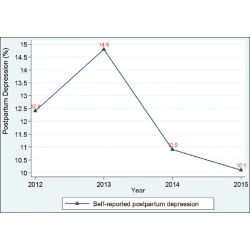
Background: Postpartum depression (PPD) is the most common morbidity among new mothers. With an estimated 140,000 resident births annually in the state of Pennsylvania, United States, no publication is available about the prevalence and risk factors associated with PPD specifically for Pennsylvania. This study aims to estimate the self-reported prevalence and risk factors associated with PPD. Methods: Weighted Pregnancy Risk Assessment Monitoring System (PRAMS) surveillance data of 4,022 Pennsylvania mothers with live birth(s) during 2012-2015 were analyzed. Descriptive statistics were used for mothers’ characteristics. Between-group differences were evaluated using the Chi-square test. Risk factors associated with PPD were analyzed by logistic regression models. All analyses were performed using Stata version 13 (STATA Corp., College Station, TX), taking into account the complex survey design, and P-values <0.05 (2-tailed) were considered statistically significant. Results: Of the 4,022 mothers, the overall prevalence of PPD was 12.1% (515 mothers); the prevalence was 12.4% (108) in 2012, spiked to 14.8% (156) in 2013, then significantly declined to 10.9% (127) in 2014 and 10.1% (124) in 2015 (p=0.03). In a multivariable logistic model, significant risk factors included depression before pregnancy (adjusted odds ratio [aOR]: 3.7, 95% CI: 2.3-6.0), abuse before or during pregnancy (aOR: 3.5, 95% CI: 1.6-7.3), the mother’s job loss (aOR: 2.1, 95% CI: 1.3-3.4), extended time away from husband/partner due to military deployment or work-related travel (aOR: 2.3, 95% CI: 1.1-4.5), a husband/partner not wanting the pregnancy (aOR: 1.7, 95% CI: 1.1-2.9), and arguing more than usual with a husband/partner (aOR: 1.6, 95% CI: 1.4-2.4). Conclusion and Implication for Translation: PPD is relatively common in Pennsylvania; however, the prevalence declined significantly during the study period. Depression before pregnancy, abuse before or during pregnancy, job loss, extended time away from husband/partner due to military deployment or workrelated travel, husband/partner not wanting the pregnancy, or arguing more than usual with a husband/ partner increased the odds of experiencing PPD. Further studies should be conducted on approaches to prevent PPD among new mothers.
Downloads
Similar Articles
- Elisa J. Gordon, Zubairu Iliyasu, Elizabeth S. Rose, Fatimah I. Tsiga-Ahmed, Usman J. Wudil, Aishatu L. Adamu, C. William Wester, Muktar H. Aliyu, Building Capacity for the Ethical Conduct of Genetic and Genomic Research in Nigeria: The Vanderbilt-Nigeria Research Ethics Training Program , Vol. 9 No. Continuous (2025): The International Journal of Translational Medical Research and Public Health (IJTMRPH)
- Laura Elisabeth Gressler, Andrej Radoja, Terrie Cowley, Deanne Clare, John Kusiak, Allen Cowley, Temporomandibular Disorders at a Crossroads: Meeting Summary , Vol. 9 No. Special Collection (2025): The International Journal of Translational Medical Research and Public Health (IJTMRPH)
- Deepa Dongarwar, Brisa Y Garcia, Nisha Jacob, Hamisu M Salihu, Racial/Ethnic Disparities in Temporal Trends of Myocardial Infarction Hospitalizations Among Pregnant Women in the United States: 2009-2018 , Vol. 5 No. 2 (2021): The International Journal of Translational Medical Research and Public Health (IJTMRPH)
- Musa Baba Maiyaki, Garba Dahiru, Amina Abdullahi, Tijjani Hussaini, Sabitu Shuaibu, Mohammed Auwal Ibrahim, Auwal Adamu, Nura Mohammed, Mahmoud Habib Maje, Hamisu M Salihu, Profiles and Characteristics of Patients with Mild to Moderate COVID -19 Disease Phenotypes in a Teaching Hospital in Kano, Northern Nigeria , Vol. 6 No. 1 (2022): The International Journal of Translational Medical Research and Public Health (IJTMRPH)
- Albert Apotele Nyaaba, Edward Kwabena Ameyaw, Matthew Ayamga, Beyond the COVID-19 Vaccine: The “Epidemic” of Violence in Ghana and Strategies to Keep Women and Children Safe from Gender-Based Violence , Vol. 6 No. 1 (2022): The International Journal of Translational Medical Research and Public Health (IJTMRPH)
- Elizabeth Afibah Armstrong-Mensah, Ato Kwamena Tetteh, HIV Prevention in sub-Saharan Africa: Where Are Adolescents in the Continuum? , Vol. 5 No. 2 (2021): The International Journal of Translational Medical Research and Public Health (IJTMRPH)
- Laila Al Afnan, Hunger in America: Examining the Far–Reaching Effects of Food Insecurity in the United States of America , Vol. 8 No. Continuous (2024): The International Journal of Translational Medical Research and Public Health (IJTMRPH)
- Gordon Amadi, Samuel C Iwuji, Taofik O Azeez, Chidozie J Nwaokoro, Chioma O Wodu, Biochemical Effects of Piper Guineense (African Black Pepper) in Female Diabetics: Opportunities for Diabetes Treatment , Vol. 3 No. 1 (2019): The International Journal of Translational Medical Research and Public Health (IJTMRPH)
- Michael Quinn Patton, Laura Elisabeth Gressler, Sustainable, Cooperative, Inclusive, Organized Networks, and Translational Health: A Book Review of Saving Societies from Within: Innovation and Equity through Inter-Organizational Networks , Vol. 9 No. Special Collection (2025): The International Journal of Translational Medical Research and Public Health (IJTMRPH)
- Nasir Ilyas, Romuladus E Azuine, Alina Tamiz, COVID-19 Pandemic in Pakistan , Vol. 4 No. 1 (2020): The International Journal of Translational Medical Research and Public Health (IJTMRPH)
<< < 7 8 9 10 11 12 13 14 15 > >>
You may also start an advanced similarity search for this article.
Published
How to Cite
Issue
Section
License
Copyright © 2021 Nhiem Luong, Sara E Thuma, Angelo Santore, Zhen-qiang Ma, Sharon M Watkins, Erin McCarty. Published by Global Health and Education Projects, Inc., USA.

This is an open-access article distributed under the terms of the Creative Commons Attribution-NonCommercial-ShareAlike 4.0 International License , which permits others to remix, transform, and build upon the work non-commercially, provided the original author is credited and the new creations are licensed under the same terms.



 .
.

