
Prevalence and Associated Risk Factors of Postpartum Depression among Mothers in Pennsylvania, United States: An Analysis of the Pregnancy Risk Assessment Monitoring System (PRAMS) Data, 2012-2015
DOI:
https://doi.org/10.21106/ijtmrph.386Keywords:
- Depression,
- Postpartum Depression,
- Prevalence,
- Risk Factors,
- Surveillance,
- Pregnancy,
- Maternal Health,
- PRAMS
Abstract
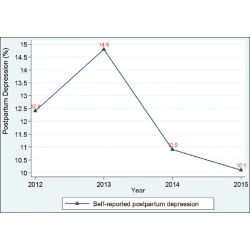
Background: Postpartum depression (PPD) is the most common morbidity among new mothers. With an estimated 140,000 resident births annually in the state of Pennsylvania, United States, no publication is available about the prevalence and risk factors associated with PPD specifically for Pennsylvania. This study aims to estimate the self-reported prevalence and risk factors associated with PPD. Methods: Weighted Pregnancy Risk Assessment Monitoring System (PRAMS) surveillance data of 4,022 Pennsylvania mothers with live birth(s) during 2012-2015 were analyzed. Descriptive statistics were used for mothers’ characteristics. Between-group differences were evaluated using the Chi-square test. Risk factors associated with PPD were analyzed by logistic regression models. All analyses were performed using Stata version 13 (STATA Corp., College Station, TX), taking into account the complex survey design, and P-values <0.05 (2-tailed) were considered statistically significant. Results: Of the 4,022 mothers, the overall prevalence of PPD was 12.1% (515 mothers); the prevalence was 12.4% (108) in 2012, spiked to 14.8% (156) in 2013, then significantly declined to 10.9% (127) in 2014 and 10.1% (124) in 2015 (p=0.03). In a multivariable logistic model, significant risk factors included depression before pregnancy (adjusted odds ratio [aOR]: 3.7, 95% CI: 2.3-6.0), abuse before or during pregnancy (aOR: 3.5, 95% CI: 1.6-7.3), the mother’s job loss (aOR: 2.1, 95% CI: 1.3-3.4), extended time away from husband/partner due to military deployment or work-related travel (aOR: 2.3, 95% CI: 1.1-4.5), a husband/partner not wanting the pregnancy (aOR: 1.7, 95% CI: 1.1-2.9), and arguing more than usual with a husband/partner (aOR: 1.6, 95% CI: 1.4-2.4). Conclusion and Implication for Translation: PPD is relatively common in Pennsylvania; however, the prevalence declined significantly during the study period. Depression before pregnancy, abuse before or during pregnancy, job loss, extended time away from husband/partner due to military deployment or workrelated travel, husband/partner not wanting the pregnancy, or arguing more than usual with a husband/ partner increased the odds of experiencing PPD. Further studies should be conducted on approaches to prevent PPD among new mothers.
Downloads
Similar Articles
- Uksim Qadri, Bashir Ahmad Fomda, Saleem Javaid Wani, Shugufta Roohi, Sanam Rasool Wani, Hepatitis A and E: Prevalence, Epidemiology and Co-infection among Patients with Acute Viral Hepatitis , Vol. 9 No. Continuous (2025): The International Journal of Translational Medical Research and Public Health (IJTMRPH)
- Victoria Funmilayo Hanson, Olayinka A Onasoga, Christianah Olayemi Babalola, Working Conditions and Productivity among Nurses in Selected Hospitals in Southwest Nigeria , Vol. 1 No. 2 (2017): The International Journal of Translational Medical Research and Public Health (IJTMRPH)
- Nsofwa Jubedah Mwansa, Victor Daka, David Mulenga, Ruth L Mfune, Bright Mukanga, Christopher Nyirenda, Seter Siziya, Correlates of Seizure Control Among Patients with Epilepsy at Two Referral Hospitals in Zambia , Vol. 4 No. 2 (2020): The International Journal of Translational Medical Research and Public Health (IJTMRPH)
- Sitratullah O Maiyegun, Korede K Yusuf, Deepa Dongarwar, Sahra Ibrahimi, Chioma Ikedionwu, Hamisu M Salihu, COVID-19: How Can Doulas Support Pandemic Control? , Vol. 5 No. 2 (2021): The International Journal of Translational Medical Research and Public Health (IJTMRPH)
- Deepa Dongarwar, Ebubechi K Adindu, Ruth Mizu, Hamisu M Salihu, Racial/Ethnic Disparities in Preeclampsia, Eclampsia, and HELLP Syndrome Hospitalizations Rates in the United States , Vol. 6 No. 1 (2022): The International Journal of Translational Medical Research and Public Health (IJTMRPH)
- Mohamed Rida Tagajdid, Safae Elkochri, Hicham Elannaz, Rachid Abi, Idriss Lahlou Amine, Epidemiological, Clinical and Virological Characteristics of Patients with Hepatitis C in Morocco , Vol. 4 No. 1 (2020): The International Journal of Translational Medical Research and Public Health (IJTMRPH)
- Abhijit Dey, Rajat Basu, Poulami Basu, Simran Keshri, Bandita Sengupta, Sandip Roy, Prevention Versus Treatment: Barriers to Tuberculosis Prevention and Treatment in Urban Areas , Vol. 9 No. Continuous (2025): The International Journal of Translational Medical Research and Public Health (IJTMRPH)
- Pragya Paneru, Samyog Uprety, Shyam S Budhathoki, Birendra K Yadav, Suman L Bhandari, Willingness to Become Deceased Organ Donors among Post‑graduate Students in Selected Colleges in Kathmandu Valley, Nepal , Vol. 3 No. 1 (2019): The International Journal of Translational Medical Research and Public Health (IJTMRPH)
- Anushka Banerjee, Abhijit G. Banerjee, Chronic Inflammation in Polycystic Ovarian Syndrome: Examining Biomarker–Driven Control Strategies to Reduce Population–Level Disease Burden , Vol. 8 No. Continuous (2024): The International Journal of Translational Medical Research and Public Health (IJTMRPH)
- Precious Okechukwu Eteike, Evangeline Tochi Oparaocha, Antimalarial Drug Efficacy of Artemether-Lumefantrine in Subclinical Malaria in Southeastern Nigeria , Vol. 1 No. 2 (2017): The International Journal of Translational Medical Research and Public Health (IJTMRPH)
<< < 6 7 8 9 10 11 12 13 14 15 > >>
You may also start an advanced similarity search for this article.
Published
How to Cite
Issue
Section
License
Copyright © 2021 Nhiem Luong, Sara E Thuma, Angelo Santore, Zhen-qiang Ma, Sharon M Watkins, Erin McCarty. Published by Global Health and Education Projects, Inc., USA.

This is an open-access article distributed under the terms of the Creative Commons Attribution-NonCommercial-ShareAlike 4.0 International License , which permits others to remix, transform, and build upon the work non-commercially, provided the original author is credited and the new creations are licensed under the same terms.



 .
.

