
Diagnosis of Sickle Cell Disease in Gabon Using Sickle SCAN®: A Point-of-Care Blood Test
DOI:
https://doi.org/10.21106/ijtmrph.315Keywords:
- Sickle Cell Disease,
- Phenotypic Diagnosis,
- Sickle SCAN®,
- Capillary Electrophoresis,
- Gabon
Abstract
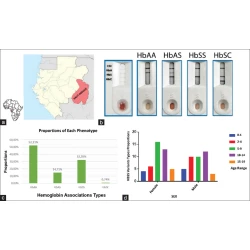
Background: Sickle cell disease (SCD) is the world’s most common genetic blood disorder. Most infant deaths from SCD occur in sub-Saharan Africa, and the mortality rate is exceptionally high in Gabon in Central Africa. In Gabon, there are limited resources for early and accurate detection of sickle cell or trait conditions. Most affected individuals reside in low-resource areas where access to diagnostic testing is often very limited. The most commonly used diagnostic methods require trained staff, adequate infrastructure, electric power, and enough time to perform the analysis. These requirements do not currently allow mass screening to be performed in remote areas of Gabon. The purpose of this pilot study is to develop a standardized screening procedure for SCD in order to determine its prevalence in the southeast area of Gabon by using a rapid and reliable test that does not require significant resources, such as the Sickle SCAN® device. Methods: The accuracy of the Sickle SCAN® device was assessed based on testing 272 blood samples. The exact hemoglobin was identified in 100% of the samples. The test comprises three proprietary indicators that detect the presence of hemoglobin A, S, and C, thus allowing the user to rapidly distinguish between normal (HbAA, N=142), carrier (HbAS, N=41), and sickle cell disease (HbSS, N=88; HbSC, N=1) samples. Hemoglobin variants (S and C) were confirmed by capillary electrophoresis (MinicapR; Sebia). The sensitivity and specificity were calculated for each phenotype. Results: The Sickle SCAN® test analysis revealed the following normal and abnormal phenotypes, including sickle cell trait (HbAS=14,71%) and SCD [HbSS (32.35%) and HbSC (0,74)]. There are no false positives in Sickle SCAN® result for the presence of hemoglobin variant, compared to gold standard approaches to capillary electrophoresis. The estimated sensitivity of the Sickle Scan® test was 92.2%, 100%, and 100% for HbSS, HbAS, and HbSC, respectively. The specificity exceeded 88.23% for all phenotypes (HbSS, HbAS, and HbSC). Conclusion and Implications for Translation:The Sickle Scan® device was found to be reliable with a sensitivity of 92.2%, 100%, and 100% for HbSS, HbAS, and HbSC, respectively. The specificity exceeded 88% for all phenotypes.
Downloads
Similar Articles
- Mayowa Jeremiah Adeniyi, Ayoola Awosika, Samuel Agaba Ameh, John Obogwu, Samuel Ijoganu, Phoebe Nwamaka Kanikwu, Impact of Short-Term Hot Water Hand Immersion on Physiological Responses to Different Orthostatic Durations , Vol. 10 (2026): The International Journal of Translational Medical Research and Public Health (IJTMRPH)
- Deepa Dongarwar, Hamisu M Salihu, COVID-19 Vaccination Rates by Global Universal Health Care Coverage Status , Vol. 5 No. 1 (2021): The International Journal of Translational Medical Research and Public Health (IJTMRPH)
- Gopal K Singh, Hyunjung Lee, Romuladus E Azuine, Increasing Trends in Physical and Mental Health Problems among US Workers in Different Job Sectors During the COVID-19 Pandemic , Vol. 5 No. 2 (2021): The International Journal of Translational Medical Research and Public Health (IJTMRPH)
- Hyunjung Lee, Gopal K Singh, Association of Happiness and Life Satisfaction with Cancer Mortality in the United States: A Longitudinal Analysis , Vol. 4 No. 2 (2020): The International Journal of Translational Medical Research and Public Health (IJTMRPH)
- Deepa Dongarwar, Brisa Y Garcia, Nisha Jacob, Hamisu M Salihu, Racial/Ethnic Disparities in Temporal Trends of Myocardial Infarction Hospitalizations Among Pregnant Women in the United States: 2009-2018 , Vol. 5 No. 2 (2021): The International Journal of Translational Medical Research and Public Health (IJTMRPH)
- Deepa Dongarwar, Karla Moriel, Kobby A Wiafe, Hamisu M Salihu, Sex and Age-Based Differences in Adult Acute Myeloid Leukemia Hospitalizations in the United States, 2009-2018 , Vol. 6 No. 1 (2022): The International Journal of Translational Medical Research and Public Health (IJTMRPH)
- semvua kilonzo, Hyasinta Jaka, Sylvanus Mapunda, Knowledge and Risk Assessment of Hepatitis B Infection among Barbers and Beauty Salon Workers in Mwanza, Tanzania , Vol. 8 No. Continuous (2024): The International Journal of Translational Medical Research and Public Health (IJTMRPH)
- Caroline Mtaita, Samuel Likindikoki, Shishira Mnjokava, Gaspar Mbita, Elvis Safary, Dawud Hilliard, Albrecht Jahn, Accessibility to Gender-based Violence Health Services for Adolescent Girls and Young Women in Tanzania , Vol. 5 No. 2 (2021): The International Journal of Translational Medical Research and Public Health (IJTMRPH)
- Oluwatosin Olateju, Ilona Argirion, Melanie Bolden, Stephanie Klapper, Jonas Nguh, Chidubem Egboluche, Addressing Health Disparities in Maryland Communities: Insights from a Public Health State Affiliate and Strategic Advocacy Recommendations , Vol. 9 No. Continuous (2025): The International Journal of Translational Medical Research and Public Health (IJTMRPH)
- Gopal K. Singh, Hyunjung Lee, Lyoung Hee Kim, Gem P Daus, Promoting Health Literacy as an Important Initiative in Reducing Health Disparities and Advancing Health Equity , Vol. 8 No. Continuous (2024): The International Journal of Translational Medical Research and Public Health (IJTMRPH)
<< < 3 4 5 6 7 8 9 10 11 12 > >>
You may also start an advanced similarity search for this article.
Published
How to Cite
Issue
Section
License
Copyright © 2022 Lucrèce M Delicat-Loembet, A.D. Nno Mabiala, Ulrich Bisvigou, Eveline Avoune, Solange Bongo, André N’Tchoreret, Arnaud Kouoyo, Alain Ondo, Alexis E Dokekias, Jean Koko, Simon Ategbo. Published by Global Health and Education Projects, Inc., USA.

This is an open-access article distributed under the terms of the Creative Commons Attribution-NonCommercial-ShareAlike 4.0 International License , which permits others to remix, transform, and build upon the work non-commercially, provided the original author is credited and the new creations are licensed under the same terms.



 .
.

