
Hypertension in Saudi Arabia: Assessing Life Style and Attitudes
DOI:
https://doi.org/10.21106/ijtmrph.112Keywords:
- DASH,
- Hypertension,
- Life Style,
- Knowledge,
- Saudi Arabia
Abstract
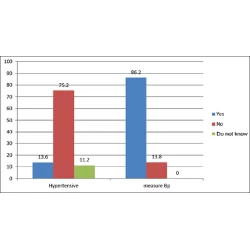
Background: The Dietary Approaches to Stop Hypertension (DASH) diet lowers blood pressure (BP) effectively. There is evidence that strongly supports the concept that lifestyle modification has a powerful effect on BP. The DASH diet includes increased physical activity, reduced salt intake, weight loss, increased potassium intake, and an overall healthy dietary pattern. This study assesses the knowledge and attitudes of Saudis in Riyadh City towards lifestyle and hypertension. Methods: A cross-sectional study was designed using a questionnaire-based assessment tool, which included sociodemographic data, knowledge and lifestyle attitudes toward hypertension, such as dietary factors, stress, smoking, physical activities, and diet-related diseases (including obesity and diabetes mellitus). Statistical analyses to examine the perceived association between lifestyle factors and hypertension risks included frequency distribution, percentages, and chi-square tests of significance. Results: Out of 934 total participants, 13.6% were hypertensive; 84.4% and 60.2% of participants believed eating salty food and fatty food, respectively, were risk factors for hypertension. Almost 66.0% of participants considered stress as a risk factor for the development of hypertension, whereas 77.0% considered smoking as a risk factor. The data showed that 87.5% considered obesity as a risk factor, and 73.8% considered reducing weight as a preventive measure for hypertension. Also, 68.8% believed that physical inactivity was a risk factor for hypertension. Data showed that 16.6 % ate vegetables and 23.1% ate fruits as recommended, whereas 18.8% and 18.4%, respectively, rarely ate vegetables and fruits. About 12.1% smoked and 19.7% exercised regularly, whereas 15.6% did not exercise at all. Traffic and examination were reported as stress factors by younger participants. Conclusion and Implications for Translation:The knowledge of the relationship between hypertension risk factors and eating salty or fatty food was high. In contrast, knowledge of not eating vegetables and fruits as a risk factor for the development of hypertension was very low among the Saudis.
Downloads
Similar Articles
- Ekidor Ateyo Lokorio, Isaac Mwanzo, Gordon Ogweno, Voluntary Medical Male Circumcision Services and Related Psychosocial Factors Among Men in Kenya , Vol. 8 No. Continuous (2024): The International Journal of Translational Medical Research and Public Health (IJTMRPH)
- Leah Claus, Sara S Jarvis, Building Trust: Strategies for Recruiting Underrepresented Populations in Research during the COVID-19 Pandemic , Vol. 7 No. 1 (2023): The International Journal of Translational Medical Research and Public Health (IJTMRPH)
- Dania Matta, Patti Herring, W. Lawrence Beeson, Seth Wiafe, The Role of Perceived Susceptibility, Perceived Severity, Perceived Barriers and Benefits in COVID-19 Vaccine Hesitancy and Uptake Among Outpatient Surgery Nurses in the United States: A Qualitative Study , Vol. 7 No. 1 (2023): The International Journal of Translational Medical Research and Public Health (IJTMRPH)
- Hyunjung Lee, Gopal K Singh, Racial and Ethnic Disparities in the Mental Health Impact of the COVID-19 Pandemic in the United States: Analysis of 3 Million Americans from the National Health Interview Survey and Household Pulse Survey , Vol. 6 No. 2 (2022): The International Journal of Translational Medical Research and Public Health (IJTMRPH)
- Deepa Dongarwar, Ebubechi K Adindu, Ruth Mizu, Hamisu M Salihu, Racial/Ethnic Disparities in Preeclampsia, Eclampsia, and HELLP Syndrome Hospitalizations Rates in the United States , Vol. 6 No. 1 (2022): The International Journal of Translational Medical Research and Public Health (IJTMRPH)
- Deepa Dongarwar, Brisa Y Garcia, Sitratullah O Maiyegun, Korede K Yusuf, Hamisu M Salihu, COVID-19 Early Vaccination Rates and Gross Domestic Product Per Capita , Vol. 5 No. 1 (2021): The International Journal of Translational Medical Research and Public Health (IJTMRPH)
- Hamisu M Salihu, Brisa Y Garcia, Deepa Dongarwar, Racial/Ethnic Disparities in Receipt of Lung Transplant and In-Hospital Mortality among Pediatric and Adolescent Patients in the United States , Vol. 5 No. 2 (2021): The International Journal of Translational Medical Research and Public Health (IJTMRPH)
- Albert Apotele Nyaaba, Augustine Tanle, Louis Kobina Dadzie, Matthew Ayamga, Determinants of Under-Five Mortality in Ghana: Evidence from the Ghana Demographic and Health Survey , Vol. 4 No. 2 (2020): The International Journal of Translational Medical Research and Public Health (IJTMRPH)
- Christopher S Oyamienlen, Charles A Adisa, Ikechukwu N. S Dozie, Evangeline T Oparaocha, Angelica A Anele, Kingsley C Anochiwa, Body Mass Index and Breast Cancer Risks Among Igbo Women in Imo and Abia States, Nigeria: A Case Control Study , Vol. 3 No. 1 (2019): The International Journal of Translational Medical Research and Public Health (IJTMRPH)
- Esther Ayaaba, Yi Liu, Yan Li, Lei Han, Quansah Dan Yedu, Ni Chunhu, Measures to Control the Prevalence of Pneumoconiosis in Coal Mining: A Review of the Literature , Vol. 1 No. 1 (2017): The International Journal of Translational Medical Research and Public Health (IJTMRPH)
You may also start an advanced similarity search for this article.
Published
How to Cite
Issue
Section
License
Copyright © 2020 Bushra Elbashir, Msab Al-dkheel, Hamad Aldakheel, Naif Aruwished, Nasser Alodayani. Published by Global Health and Education Projects, Inc., USA.

This is an open-access article distributed under the terms of the Creative Commons Attribution-NonCommercial-ShareAlike 4.0 International License , which permits others to remix, transform, and build upon the work non-commercially, provided the original author is credited and the new creations are licensed under the same terms.



 .
.

