
Hypertension in Saudi Arabia: Assessing Life Style and Attitudes
DOI:
https://doi.org/10.21106/ijtmrph.112Keywords:
- DASH,
- Hypertension,
- Life Style,
- Knowledge,
- Saudi Arabia
Abstract
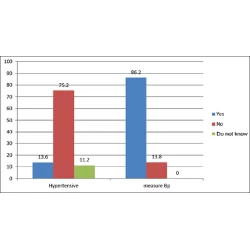
Background: The Dietary Approaches to Stop Hypertension (DASH) diet lowers blood pressure (BP) effectively. There is evidence that strongly supports the concept that lifestyle modification has a powerful effect on BP. The DASH diet includes increased physical activity, reduced salt intake, weight loss, increased potassium intake, and an overall healthy dietary pattern. This study assesses the knowledge and attitudes of Saudis in Riyadh City towards lifestyle and hypertension. Methods: A cross-sectional study was designed using a questionnaire-based assessment tool, which included sociodemographic data, knowledge and lifestyle attitudes toward hypertension, such as dietary factors, stress, smoking, physical activities, and diet-related diseases (including obesity and diabetes mellitus). Statistical analyses to examine the perceived association between lifestyle factors and hypertension risks included frequency distribution, percentages, and chi-square tests of significance. Results: Out of 934 total participants, 13.6% were hypertensive; 84.4% and 60.2% of participants believed eating salty food and fatty food, respectively, were risk factors for hypertension. Almost 66.0% of participants considered stress as a risk factor for the development of hypertension, whereas 77.0% considered smoking as a risk factor. The data showed that 87.5% considered obesity as a risk factor, and 73.8% considered reducing weight as a preventive measure for hypertension. Also, 68.8% believed that physical inactivity was a risk factor for hypertension. Data showed that 16.6 % ate vegetables and 23.1% ate fruits as recommended, whereas 18.8% and 18.4%, respectively, rarely ate vegetables and fruits. About 12.1% smoked and 19.7% exercised regularly, whereas 15.6% did not exercise at all. Traffic and examination were reported as stress factors by younger participants. Conclusion and Implications for Translation:The knowledge of the relationship between hypertension risk factors and eating salty or fatty food was high. In contrast, knowledge of not eating vegetables and fruits as a risk factor for the development of hypertension was very low among the Saudis.
Downloads
Similar Articles
- Sitratullah O Maiyegun, Korede K Yusuf, Deepa Dongarwar, Sahra Ibrahimi, Chioma Ikedionwu, Hamisu M Salihu, COVID-19: How Can Doulas Support Pandemic Control? , Vol. 5 No. 2 (2021): The International Journal of Translational Medical Research and Public Health (IJTMRPH)
- Fatima Usman, Zubairu Iliyasu, Hamisu M Salihu, Muktar H Aliyu, COVID-19 Pandemic and Medical Education in Nigeria , Vol. 5 No. 2 (2021): The International Journal of Translational Medical Research and Public Health (IJTMRPH)
- Deepa Dongarwar, Ayleen A Hernandez, Laura Miranda, Hamisu M Salihu, Examining Trends in Black-White Disparity in Traumatic Spinal Cord Injuries among Pregnancy-Related Hospitalizations in the United States , Vol. 6 No. 1 (2022): The International Journal of Translational Medical Research and Public Health (IJTMRPH)
- Nareesa Karmali, Kanisha Blake, Brownmagnus Olivers, Sussan E Ekejiuba, Romuladus E Azuine, The Effect of Maternal Vitamin D Status on Fetal Growth and Stunting: A Systematic Review , Vol. 5 No. 2 (2021): The International Journal of Translational Medical Research and Public Health (IJTMRPH)
- Victoria Funmilayo Hanson, Olayinka A Onasoga, Christianah Olayemi Babalola, Working Conditions and Productivity among Nurses in Selected Hospitals in Southwest Nigeria , Vol. 1 No. 2 (2017): The International Journal of Translational Medical Research and Public Health (IJTMRPH)
- Amina P Alio, Linxi Liu, Kelly Thevenet-Morrison, Michelle R Rubado, Hugh F Crean, Peter J Veazie, Christopher L Seplaki, Ann Dozier, Association of Voluntary Legal Paternity and Breastfeeding Duration and Exclusivity in a Sample of Mothers in NewYork State, United States , Vol. 5 No. 2 (2021): The International Journal of Translational Medical Research and Public Health (IJTMRPH)
- Angelique B Willis, Mildred Addo, Lauren E Yoder, Cassandra K Johnson, Sydney L Resler, Leticia J Young, Elizabeth Armstrong-Mensah, Individual and Community Level Factors Related to Sanitation, Water Quality, Treatment and Management in Rural Communities in Accra, Ghana: A Field Study Report , Vol. 6 No. 1 (2022): The International Journal of Translational Medical Research and Public Health (IJTMRPH)
- Hyunjung Lee, Gopal K Singh, Estimating Contributions of Social and Behavioral Factors to Cardiovascular Disease, Cancer, COPD, and Unintentional-Injury Mortality Disparities by Psychological Distress in the United States: A Blinder-Oaxaca Decomposition Analysis of the 1997-2014 NHIS , Vol. 5 No. 2 (2021): The International Journal of Translational Medical Research and Public Health (IJTMRPH)
- Ahmad Bashir Umar, Mohammed Kabir Saleh, Yahuza Mansur Adamu, Sadiq Hassan, Muktar Hassan Aliyu, Anas Ismail, Ocular Health Complications Among People Living with HIV/AIDS in Nigeria: Leveraging Doppler Ultrasonography to Identify and Manage Risk Factors , Vol. 9 No. Continuous (2025): The International Journal of Translational Medical Research and Public Health (IJTMRPH)
- George Ikpe, Juliet Enukeme, Chukwuemeka Amuta, Ikenna Nwakanma, Orieji Agomoh, Okwudili Chukwudinma, Chioma Ukanwa, Peter Nwaokenneya, Advanced HIV Disease among Persons Newly Diagnosed with HIV: A Hospital-Based Study in Abia State, Nigeria , Vol. 9 No. Continuous (2025): The International Journal of Translational Medical Research and Public Health (IJTMRPH)
<< < 3 4 5 6 7 8 9 10 11 12 > >>
You may also start an advanced similarity search for this article.
Published
How to Cite
Issue
Section
License
Copyright © 2020 Bushra Elbashir, Msab Al-dkheel, Hamad Aldakheel, Naif Aruwished, Nasser Alodayani. Published by Global Health and Education Projects, Inc., USA.

This is an open-access article distributed under the terms of the Creative Commons Attribution-NonCommercial-ShareAlike 4.0 International License , which permits others to remix, transform, and build upon the work non-commercially, provided the original author is credited and the new creations are licensed under the same terms.



 .
.

