
The Role of Health Belief Model in HIV Screening Decision among International Students in the United States: A Pilot Study
DOI:
https://doi.org/10.21106/ijtmrph.99Keywords:
- HIV,
- HIV screening,
- Decision,
- Acceptance,
- Perceived Benefit,
- Perceived Threat,
- Perceived Susceptibility,
- Health Belief Model,
- International Students
Abstract
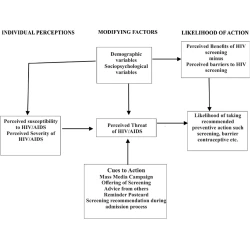
Objectives: We sought to determine how the Health Belief Model (HBM) constructs relate to Human Immunodeficiency Virus (HIV) screening decisions among international students and which of the HBM constructs was most relevant in those screening decisions. Methods: We conducted a cross-sectional pilot study using an online survey of international students at Western Illinois University in the United States. Participants signed electronic informed consent. The online survey comprised of questions that assessed their sociodemographic characteristics, acceptance of HIV screening, and perceived knowledge of HIV. The survey also determined the role of perceived benefits, perceived threat, and cues to action in making HIV screening decisions among the study population. Results: Four hundred and ninety students were invited to participate in the survey out of which 185 responses were obtained. In all, 107(57.8%) were males, and 78(42.8%) were females. Most of the respondents were from Asia (64.9%) and Africa (24.9%). The prevalence of acceptance of HIV screening among international students was found to be 73.5%. About 90% of the participants perceived HIV screening to be beneficial to their health, and 76% of them would accept the screening because they were offered. The majority (83%) of participants who said that they would not accept HIV screening, were also not sexually active, and they did not think they could be susceptible to HIV. Conclusion and Implications for Translation: Perceived benefits and cues to action were found to be the significant factors that informed the decision of people who accepted to be screened for HIV. Perceived susceptibility informed the decision of those that rejected the screening. Caution is warranted in generalizing the findings from this study because of the limited sample size; however, we are confident that our findings are reproducible in a larger population context.
Downloads
Similar Articles
- Elizabeth A Armstrong-Mensah, Transitioning a Public Health Study Abroad Program to Virtual Format During the COVID-19 Pandemic: Implications for Public Health Practice , Vol. 6 No. 1 (2022): The International Journal of Translational Medical Research and Public Health (IJTMRPH)
- Dania Matta, Patti Herring, W. Lawrence Beeson, Seth Wiafe, The Role of Perceived Susceptibility, Perceived Severity, Perceived Barriers and Benefits in COVID-19 Vaccine Hesitancy and Uptake Among Outpatient Surgery Nurses in the United States: A Qualitative Study , Vol. 7 No. 1 (2023): The International Journal of Translational Medical Research and Public Health (IJTMRPH)
- Comfort Z Olorunsaiye, Hannah M Degge, Jiana Saigh, Association Between Source of Treatment and Quality of Childhood Diarrhea Management Among Under-Five Children in Nigeria , Vol. 5 No. 2 (2021): The International Journal of Translational Medical Research and Public Health (IJTMRPH)
- Hyunjung Lee, Gopal K Singh, Racial and Ethnic Disparities in the Mental Health Impact of the COVID-19 Pandemic in the United States: Analysis of 3 Million Americans from the National Health Interview Survey and Household Pulse Survey , Vol. 6 No. 2 (2022): The International Journal of Translational Medical Research and Public Health (IJTMRPH)
- Mayowa Jeremiah Adeniyi, Ayoola Awosika, Samuel Agaba Ameh, John Obogwu, Samuel Ijoganu, Phoebe Nwamaka Kanikwu, Impact of Short-Term Hot Water Hand Immersion on Physiological Responses to Different Orthostatic Durations , Vol. 10 (2026): The International Journal of Translational Medical Research and Public Health (IJTMRPH)
- Bright Opoku Ahinkorah, Abdul-Aziz Seidu, Eugene Budu, Ebenezer Kwesi Armah-Ansah, Ebenezer Agbaglo, Collins Adu, Edward Kwabena Ameyaw, Sanni Yaya, Factors Associated with Utilization of Postnatal Care Services in Mali, West Africa Bright Opoku Ahin , Vol. 5 No. 1 (2021): The International Journal of Translational Medical Research and Public Health (IJTMRPH)
- Emmanuel Nwanya, Evangeline T Oparaocha, Book of Abstracts: 4th International Congress on Health Sciences and Technology Organized by the School of Health Technology, Federal University of Technology (FUTO), Owerri, Imo State, Nigeria, 7-9 August, 2019 , Vol. 3 No. S1 (2019): The International Journal of Translational Medical Research and Public Health (IJTMRPH)
- Albert Apotele Nyaaba, Augustine Tanle, Louis Kobina Dadzie, Matthew Ayamga, Determinants of Under-Five Mortality in Ghana: Evidence from the Ghana Demographic and Health Survey , Vol. 4 No. 2 (2020): The International Journal of Translational Medical Research and Public Health (IJTMRPH)
- Chongo Clays Siwale, Seter Siziya, Factors Associated with Alcohol Consumption Among Students in High-Cost Schools in Lusaka, Zambia , Vol. 3 No. 1 (2019): The International Journal of Translational Medical Research and Public Health (IJTMRPH)
- Romuladus E. Azuine, Gopal K. Singh, Rowena C. Saplala, The Journey So Far: Welcoming Our New Editor and Journal Progress Report , Vol. 9 No. Special Collection (2025): The International Journal of Translational Medical Research and Public Health (IJTMRPH)
<< < 1 2 3 4 5 6 7 8 9 10 > >>
You may also start an advanced similarity search for this article.
Published
How to Cite
Issue
Section
License
Copyright © 2020 Oluwasola Stephen Ayosanmi, Lorette Oden, Titilope Ayosanmi, Babatunde Alli, Mei Wen, Jamie Johnson. Published by Global Health and Education Projects, Inc., USA.

This is an open-access article distributed under the terms of the Creative Commons Attribution-NonCommercial-ShareAlike 4.0 International License , which permits others to remix, transform, and build upon the work non-commercially, provided the original author is credited and the new creations are licensed under the same terms.



 .
.

