
The Role of Health Belief Model in HIV Screening Decision among International Students in the United States: A Pilot Study
DOI:
https://doi.org/10.21106/ijtmrph.99Keywords:
- HIV,
- HIV screening,
- Decision,
- Acceptance,
- Perceived Benefit,
- Perceived Threat,
- Perceived Susceptibility,
- Health Belief Model,
- International Students
Abstract
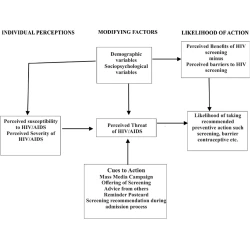
Objectives: We sought to determine how the Health Belief Model (HBM) constructs relate to Human Immunodeficiency Virus (HIV) screening decisions among international students and which of the HBM constructs was most relevant in those screening decisions. Methods: We conducted a cross-sectional pilot study using an online survey of international students at Western Illinois University in the United States. Participants signed electronic informed consent. The online survey comprised of questions that assessed their sociodemographic characteristics, acceptance of HIV screening, and perceived knowledge of HIV. The survey also determined the role of perceived benefits, perceived threat, and cues to action in making HIV screening decisions among the study population. Results: Four hundred and ninety students were invited to participate in the survey out of which 185 responses were obtained. In all, 107(57.8%) were males, and 78(42.8%) were females. Most of the respondents were from Asia (64.9%) and Africa (24.9%). The prevalence of acceptance of HIV screening among international students was found to be 73.5%. About 90% of the participants perceived HIV screening to be beneficial to their health, and 76% of them would accept the screening because they were offered. The majority (83%) of participants who said that they would not accept HIV screening, were also not sexually active, and they did not think they could be susceptible to HIV. Conclusion and Implications for Translation: Perceived benefits and cues to action were found to be the significant factors that informed the decision of people who accepted to be screened for HIV. Perceived susceptibility informed the decision of those that rejected the screening. Caution is warranted in generalizing the findings from this study because of the limited sample size; however, we are confident that our findings are reproducible in a larger population context.
Downloads
Similar Articles
- Elizabeth Armstrong-Mensah , Niha Mitha, Aireona McNair, The Mental Health of Syrian Refugees in the United States: Examining Critical Risk Factors and Major Barriers to Mental Health Care Access , Vol. 7 No. 1 (2023): The International Journal of Translational Medical Research and Public Health (IJTMRPH)
- Mariam Amer Al-Tell, Khulud Mansor, Stress Coping Strategies Among Secondary School-Aged Students in Government Schools in Northern West Bank/Palestine , Vol. 3 No. 1 (2019): The International Journal of Translational Medical Research and Public Health (IJTMRPH)
- Nur Ikazareen Dahlan, Nor Shahrul Nizam Muhamad Nor, Firdaus Yusof, Noor Halilah Buari, Contact Lens Use and Prescribing Trends in Suburban Selangor, Malaysia: A Retrospective Study , Vol. 10 (2026): The International Journal of Translational Medical Research and Public Health (IJTMRPH)
- Laila Al Afnan, Insights into Smoking Behaviors among University Students in Jordan: A Narrative Review , Vol. 9 No. Continuous (2025): The International Journal of Translational Medical Research and Public Health (IJTMRPH)
- Elizabeth Afibah Armstrong-Mensah, Ato Kwamena Tetteh, HIV Prevention in sub-Saharan Africa: Where Are Adolescents in the Continuum? , Vol. 5 No. 2 (2021): The International Journal of Translational Medical Research and Public Health (IJTMRPH)
- Elijah K Martin, Lea Jacobson, Gopal K Singh, Payam Sheikhatari, Mehrete Girmay, Smoking-Free Policies and Smoking Behaviors among Historically Black Colleges and Universities Students in the United States , Vol. 4 No. 2 (2020): The International Journal of Translational Medical Research and Public Health (IJTMRPH)
- Mahendra Arnold, Sepali Wickramatilake, Palitha Karunapema, Dinusha Fernando, Roshan Sampath, Buddhika Mahesh, Sujeewa Panditharathna, Referral Outcomes of Identified Health Problems and Difficulties Related to School Medical Inspections in Government Schools in an Education Zone in Sri Lanka , Vol. 4 No. 1 (2020): The International Journal of Translational Medical Research and Public Health (IJTMRPH)
- Moses M Gitonga, Kenneth K Ngure, Elizabeth E Echoka, Effectiveness of a Community Level Maternal Health Intervention in Improving Uptake of Postnatal Care in Migori County, Kenya , Vol. 3 No. 1 (2019): The International Journal of Translational Medical Research and Public Health (IJTMRPH)
- Matiur Rahman, Md. Aminur Rahman, Md. Kaoser Bin Siddique, Md. Rahidul Islam, Mohammad Mahbub ur Rahim, Impact of COVID-19 on Essential Health Care of Rural People in Northern Bangladesh: A Cross-Sectional Study , Vol. 7 No. 1 (2023): The International Journal of Translational Medical Research and Public Health (IJTMRPH)
- George Ikpe, Juliet Enukeme, Chukwuemeka Amuta, Ikenna Nwakanma, Orieji Agomoh, Okwudili Chukwudinma, Chioma Ukanwa, Peter Nwaokenneya, Advanced HIV Disease among Persons Newly Diagnosed with HIV: A Hospital-Based Study in Abia State, Nigeria , Vol. 9 No. Continuous (2025): The International Journal of Translational Medical Research and Public Health (IJTMRPH)
<< < 1 2 3 4 5 6 7 8 9 10 > >>
You may also start an advanced similarity search for this article.
Published
How to Cite
Issue
Section
License
Copyright © 2020 Oluwasola Stephen Ayosanmi, Lorette Oden, Titilope Ayosanmi, Babatunde Alli, Mei Wen, Jamie Johnson. Published by Global Health and Education Projects, Inc., USA.

This is an open-access article distributed under the terms of the Creative Commons Attribution-NonCommercial-ShareAlike 4.0 International License , which permits others to remix, transform, and build upon the work non-commercially, provided the original author is credited and the new creations are licensed under the same terms.



 .
.

