
Barriers and Facilitators to Accessing Health Care Services among Married Women in Ethiopia: a Multi-level Analysis of the Ethiopia Demographic and Health Survey
DOI:
https://doi.org/10.21106/ijtmrph.380Keywords:
- Health Care Access,
- Factors,
- Multilevel,
- Ethiopia,
- DHS,
- Global Health,
- Individual- and Community-Levels,
- Barriers,
- Facilitators
Abstract
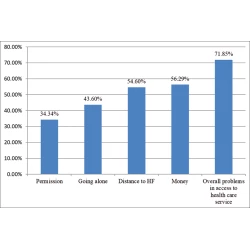
Background and Objective: Access to health care services is a major challenge to women and children in many developing countries such as Ethiopia. In this study, we investigated the individual- and communitylevel factors associated with barriers to accessing health care services among married women in Ethiopia. Methods: Data from the 2016 Ethiopia demographic and health survey on 9,824 married women of reproductive age (15-49 years) were analyzed. Multilevel logistic regression models were used to assess individual- and community-level factors associated with barriers to access health care services. Regression analysis results revealed adjusted odds ratios at 95% confidence intervals. Results: Over two-thirds (71.8%) of married women in Ethiopia reported barriers to accessing health care services. Some of the individual-level factors that were associated with lower odds of reporting barriers to access health care services include: having secondary education (aOR=0.49, 95% CI: 0.32-0.77), being in the richest quintile (aOR=0.34, 95% CI: 0.22-0.54), and indicating wife-beating as unjustified (aOR=0.66, 95% CI: 0.55-0.81). Among the community-level factors, high community-level literacy (aOR=0.56, 95% CI: 0.34-0.92) and moderate community socioeconomic status (aOR=0.62, 95% CI: 0.45-0.85) were significantly associated with lower odds of reporting barriers to access health care services. Conclusion and Implications for Translation: The findings revealed high barriers to access health care services, and both individual- and community-level factors were significant contributing predictors. Therefore, it is important to consider multidimensional strategies and interventions to facilitate access to health care services in Ethiopia.
Downloads
Most read articles by the same author(s)
- Bright Opoku Ahinkorah, Abdul-Aziz Seidu, Eugene Budu, Ebenezer Kwesi Armah-Ansah, Ebenezer Agbaglo, Collins Adu, Edward Kwabena Ameyaw, Sanni Yaya, Factors Associated with Utilization of Postnatal Care Services in Mali, West Africa Bright Opoku Ahin , International Journal of Translational Medical Research and Public Health: Vol. 5 No. 1 (2021): The International Journal of Translational Medical Research and Public Health (IJTMRPH)
- Bright Opoku Ahinkorah, Edward Kwabena Ameyaw, Abdul-Aziz Seidu, Sanni Yaya, Predictors of Female Genital Mutilation or Cutting Among Daughters of Women in Guinea, West Africa , International Journal of Translational Medical Research and Public Health: Vol. 5 No. 1 (2021): The International Journal of Translational Medical Research and Public Health (IJTMRPH)
- Albert Apotele Nyaaba, Edward Kwabena Ameyaw, Matthew Ayamga, Beyond the COVID-19 Vaccine: The “Epidemic” of Violence in Ghana and Strategies to Keep Women and Children Safe from Gender-Based Violence , International Journal of Translational Medical Research and Public Health: Vol. 6 No. 1 (2022): The International Journal of Translational Medical Research and Public Health (IJTMRPH)
Similar Articles
- Bashir Faiza, Hassan Mehmood, Sumera Naz, Saima Naz, Prevalence and Determinants of Substance Abuse Among Slum Dwellers in Islamabad- Pakistan , Vol. 3 No. 2 (2019): The International Journal of Translational Medical Research and Public Health (IJTMRPH)
- Victoria Funmilayo Hanson, Olayinka A Onasoga, Christianah Olayemi Babalola, Working Conditions and Productivity among Nurses in Selected Hospitals in Southwest Nigeria , Vol. 1 No. 2 (2017): The International Journal of Translational Medical Research and Public Health (IJTMRPH)
- Caroline Okeke, Evangeline T Oparaocha, Book of Abstracts: 3rd International Congress on Health Sciences and Technology, School of Health Technology, Federal University of Technology Owerri, Nigeria, 8-11 August, 2018 , Vol. 2 No. S1 (2018): The International Journal of Translational Medical Research and Public Health (IJTMRPH)
- Abhijit Dey, Rajat Basu, Poulami Basu, Simran Keshri, Bandita Sengupta, Sandip Roy, Prevention Versus Treatment: Barriers to Tuberculosis Prevention and Treatment in Urban Areas , Vol. 9 No. Continuous (2025): The International Journal of Translational Medical Research and Public Health (IJTMRPH)
- Ernest Mutua, Okello B.M Agina, Isaac J Mwanzo, Prevalence and Correlates of Medication Non-adherence among Hypertensive Patients on Follow-up in Central Kenya , Vol. 7 No. 1 (2023): The International Journal of Translational Medical Research and Public Health (IJTMRPH)
- Nicholas A Sleeman, Carol Hoban, Samer Koutoubi, Sexually Transmitted Infections in Pre-Exposure Prophylaxis Patients , Vol. 7 No. 2 (2023): The International Journal of Translational Medical Research and Public Health (IJTMRPH)
- Stephenson Babatunde Ojeifo, Seun Stephen Anjorin, Birth-Weight and Risk of Breast Cancer: A Systematic Review Study , Vol. 2 No. 1 (2018): The International Journal of Translational Medical Research and Public Health (IJTMRPH)
- Lillian Lamba, Eustarckio Kazonga, Christopher Nyirenda, Rodgers Chilyabanyama, Viral Load Suppression Among Adults with HIV on Antiretroviral Therapy: Outcomes from a Lusaka District Hospital, Zambia , Vol. 9 No. Continuous (2025): The International Journal of Translational Medical Research and Public Health (IJTMRPH)
- Dania Matta, Patti Herring, W. Lawrence Beeson, Seth Wiafe, The Role of Perceived Susceptibility, Perceived Severity, Perceived Barriers and Benefits in COVID-19 Vaccine Hesitancy and Uptake Among Outpatient Surgery Nurses in the United States: A Qualitative Study , Vol. 7 No. 1 (2023): The International Journal of Translational Medical Research and Public Health (IJTMRPH)
- Amina A. Umar, Yusuf D. Jobbi, Hassan Adam Murtala, Aisha Adam Abdullahi, Muktar H. Aliyu, Sani H. Aliyu, Eknath Naik, Ololade D. Adeyemi, Deepa Dongarwar, Hamisu M. Salihu, Socioeconomic and Clinical Determinants of Nutritional Phenotypes among Children with Sickle Cell Disease , Vol. 9 No. Continuous (2025): The International Journal of Translational Medical Research and Public Health (IJTMRPH)
<< < 3 4 5 6 7 8 9 10 11 12 > >>
You may also start an advanced similarity search for this article.
Published
How to Cite
Issue
Section
License
Copyright © 2021 Betregiorgis Zegeye, Nicholas Kofi Adjei, Bright Opoku Ahinkorah, Edward Kwabena Ameyaw, Eugene Budu, Abdul-Aziz Seidu, Dina Idriss-Wheeler, Sanni Yaya. Published by Global Health and Education Projects, Inc., USA.

This is an open-access article distributed under the terms of the Creative Commons Attribution-NonCommercial-ShareAlike 4.0 International License , which permits others to remix, transform, and build upon the work non-commercially, provided the original author is credited and the new creations are licensed under the same terms.



 .
.

