
Association Between Source of Treatment and Quality of Childhood Diarrhea Management Among Under-Five Children in Nigeria
DOI:
https://doi.org/10.21106/ijtmrph.372Keywords:
- Childhood Diarrhea,
- Childhood Illnesses,
- Quality of Care,
- Under-Five Mortality,
- Nigeria
Abstract
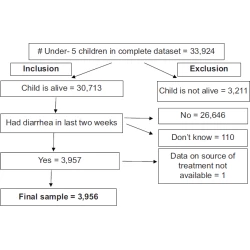
Background and Objective: Despite the availability of low-cost and effective interventions, diarrhea remains one of the leading causes of under-five morbidity and mortality in Nigeria. We assessed the relationships between the source and quality of treatment for children with diarrhea in Nigeria. Methods: We analyzed cross-sectional data on 3,956 under-five children with a recent diarrheal episode, from the 2018 Nigeria Demographic and Health Survey. The outcome was quality of diarrhea management based on the administration of the following treatment recommendations: oral rehydration salt (ORS), zinc supplementation, increased oral fluids, and continued feeding. The exposure was the source of treatment (none; traditional/informal; public hospitals/health centers; private hospitals/clinics; and community-based services). Using adjusted, multivariable logistic regression, we estimated the odds ratio (OR) and 95% confidence intervals (CI) to predict the factors related to the quality of diarrhea management. Results: In all, only 1 in 5 children received all the four recommended diarrhea interventions. The odds of good quality diarrhea management were higher among children who received treatment in public hospitals/ health centers, private hospitals/clinics, and community-based services compared to those of children who did not receive treatment (OR=2.52, 95% CI=1.89-3.34; OR=2.46, 95% CI=1.90-3.16; and OR=1.91, 95% CI=1.40-2.59, respectively). Compared to children whose parents did not seek treatment, the odds of receiving ORS ranged from 2.1 times (OR: 2.11, 95% CI=1.44-3.11) for seeking care in traditional/informal sources to 12.3 times (95% CI=8.81-17.15) in public hospitals/health centers. We observed similar trends for zinc supplementation. The odds of increased oral fluids were higher in public and private hospitals/clinics (OR=1.44, 95% CI=1.03-2.01 and OR=2.08, 95% CI=1.57-2.76, respectively). Across all settings, the odds of continued feeding were significantly lower among children who received treatment compared to children who did not receive treatment. Conclusion and Implications for Translation: Our findings indicate poor quality diarrhea management across various treatment settings. Policies and programs that encourage caregivers to seek treatment and improve the quality of care may contribute to reducing childhood diarrhea-related morbidity and mortality in Nigeria.
Downloads
Similar Articles
- Deepa Dongarwar, Ebubechi K Adindu, Ruth Mizu, Hamisu M Salihu, Racial/Ethnic Disparities in Preeclampsia, Eclampsia, and HELLP Syndrome Hospitalizations Rates in the United States , Vol. 6 No. 1 (2022): The International Journal of Translational Medical Research and Public Health (IJTMRPH)
- Elizabeth A Armstrong-Mensah, Transitioning a Public Health Study Abroad Program to Virtual Format During the COVID-19 Pandemic: Implications for Public Health Practice , Vol. 6 No. 1 (2022): The International Journal of Translational Medical Research and Public Health (IJTMRPH)
- Nsofwa Jubedah Mwansa, Victor Daka, David Mulenga, Ruth L Mfune, Bright Mukanga, Christopher Nyirenda, Seter Siziya, Correlates of Seizure Control Among Patients with Epilepsy at Two Referral Hospitals in Zambia , Vol. 4 No. 2 (2020): The International Journal of Translational Medical Research and Public Health (IJTMRPH)
- Valerie Luzi, The U.S. Opioid Crisis: Decriminalization as a Potential Approach , Vol. 4 No. 1 (2020): The International Journal of Translational Medical Research and Public Health (IJTMRPH)
- Matiur Rahman, Kaoser Bin Siddique, Mohammad Mahbub Ur Rahim, Cancer Registry in Bangladesh: Challenges and Opportunities , Vol. 8 No. Continuous (2024): The International Journal of Translational Medical Research and Public Health (IJTMRPH)
- Albert Apotele Nyaaba, Edward Kwabena Ameyaw, Matthew Ayamga, Beyond the COVID-19 Vaccine: The “Epidemic” of Violence in Ghana and Strategies to Keep Women and Children Safe from Gender-Based Violence , Vol. 6 No. 1 (2022): The International Journal of Translational Medical Research and Public Health (IJTMRPH)
- Bright Opoku Ahinkorah, Edward Kwabena Ameyaw, Abdul-Aziz Seidu, Sanni Yaya, Predictors of Female Genital Mutilation or Cutting Among Daughters of Women in Guinea, West Africa , Vol. 5 No. 1 (2021): The International Journal of Translational Medical Research and Public Health (IJTMRPH)
- Mahendra Arnold, Sepali Wickramatilake, Palitha Karunapema, Dinusha Fernando, Roshan Sampath, Buddhika Mahesh, Sujeewa Panditharathna, Referral Outcomes of Identified Health Problems and Difficulties Related to School Medical Inspections in Government Schools in an Education Zone in Sri Lanka , Vol. 4 No. 1 (2020): The International Journal of Translational Medical Research and Public Health (IJTMRPH)
- Cameran M Mosley, Emmanuel Ofori, Caylin E Andrews, Elizabeth Armstrong-Mensah, Individual and Community Level Factors Related to HIV Diagnosis, Treatment, and Stigma in Kumasi, Ghana: A Field Report , Vol. 6 No. 1 (2022): The International Journal of Translational Medical Research and Public Health (IJTMRPH)
- Elizabeth Afibah Armstrong-Mensah, Ato Kwamena Tetteh, HIV Prevention in sub-Saharan Africa: Where Are Adolescents in the Continuum? , Vol. 5 No. 2 (2021): The International Journal of Translational Medical Research and Public Health (IJTMRPH)
<< < 7 8 9 10 11 12 13 14 15 > >>
You may also start an advanced similarity search for this article.
Published
How to Cite
Issue
Section
License
Copyright © 2021 Comfort Z Olorunsaiye, Hannah M Degge, Jiana Saigh. Published by Global Health and Education Projects, Inc., USA.

This is an open-access article distributed under the terms of the Creative Commons Attribution-NonCommercial-ShareAlike 4.0 International License , which permits others to remix, transform, and build upon the work non-commercially, provided the original author is credited and the new creations are licensed under the same terms.



 .
.

