
State and Metropolitan Area Disparities in Long COVID-19 and Related Symptoms among US Adults, June-October 2022
DOI:
https://doi.org/10.21106/ijtmrph.443Keywords:
- Long COVID,
- COVID-19 Pandemic,
- Disease Severity,
- Geographic Disparities,
- Social Determinants
Abstract
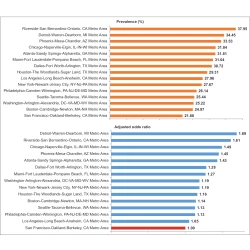
Background: Little research exists on sociodemographic and geographic inequalities in Long COVID, defined as COVID-19 symptoms lasting 3 months or longer. Using the latest nationally representative data, we examine geographic disparities in prevalence of Long COVID and severe COVID symptoms among United States (US) adults aged ≥18 years. Methods: We analyzed five consecutive rounds of the US Census Bureau’s Household Pulse Survey from June 1 to October 17, 2022 (N=108,064). Using multivariable logistic regression and health disparity indices, we modeled disparities in Long COVID and severe COVID symptoms by state and metropolitan area, controlling for race/ethnicity, socioeconomic status, health insurance, and other demographic characteristics. Results: During June–October 2022, an estimated 35.4 million or 32.2% of COVID patients in the US reported developing Long COVID; and 15.2 million or 13.8% of COVID patients reported experiencing severe COVID symptoms. The prevalence of Long COVID ranged from 24.0% in the District of Columbia (DC), 25.4% in Hawaii to 39.2% in Alabama, 39.9% in Wyoming, and 43.6% in West Virginia. Adjusted for covariates, adults with COVID-19 diagnosis in Alabama, Wyoming, and West Virginia had 48-178% higher adjusted odds of developing Long COVID than their counterparts in DC. Adults with COVID-19 diagnosis in Alabama, Arkansas, Colorado, Iowa, Kentucky, Mississippi, Montana, North Dakota, South Dakota, Texas, Utah, Virginia, Wyoming, and West Virginia had 2.0-2.5 times higher adjusted odds of experiencing severe COVID symptoms than their counterparts in Vermont. Large disparities in prevalence of Long COVID and severe COVID symptoms existed among the 15 largest metropolitan areas of the US, with the prevalence of Long COVID ranging from 21.9% in San Francisco to 38.0% in Riverside, California. Socioeconomic, demographic and health insurance characteristics explained 34% of the state-level disparity and 45% of the metropolitanarea disparity in Long COVID prevalence. Conclusion and Implications for Translation: Marked geographic disparities existed, with COVID patients/survivors in the Southeast, Southwest, and Northern Plains states being at substantially higher risks of developing Long COVID and severe COVID symptoms. Equitable access to care and support services among patients with Long COVID is critical to reducing inequities in COVID-related health outcomes.
Downloads
Most read articles by the same author(s)
- Gopal K Singh, Hyunjung Lee, Gem P Daus, Prevalence and Sociodemographic and Behavioral Correlates of Psychological Distress among Lesbian, Gay, and Bisexual Adults in the United States, 2013-2018 , International Journal of Translational Medical Research and Public Health: Vol. 6 No. 1 (2022): The International Journal of Translational Medical Research and Public Health (IJTMRPH)
- Hyunjung Lee, Gopal K Singh, Association of Happiness and Life Satisfaction with Cancer Mortality in the United States: A Longitudinal Analysis , International Journal of Translational Medical Research and Public Health: Vol. 4 No. 2 (2020): The International Journal of Translational Medical Research and Public Health (IJTMRPH)
- Gopal K Singh, Hyunjung Lee, Romuladus E Azuine, Increasing Trends in Physical and Mental Health Problems among US Workers in Different Job Sectors During the COVID-19 Pandemic , International Journal of Translational Medical Research and Public Health: Vol. 5 No. 2 (2021): The International Journal of Translational Medical Research and Public Health (IJTMRPH)
- Gopal K Singh, Hyunjung Lee, Romuladus E Azuine, Marked Inequalities in COVID-19 Vaccination by Racial/Ethnic, Socioeconomic, Geographic, and Health Characteristics, United States, January 6 – February 15, 2021 , International Journal of Translational Medical Research and Public Health: Vol. 5 No. 2 (2021): The International Journal of Translational Medical Research and Public Health (IJTMRPH)
- Gopal K Singh, Hyunjung Lee, Marked Disparities in COVID-19 Prevalence by Racial/Ethnic, Socioeconomic, Geographic, and Health Care Characteristics, United States, January – April, 2021 , International Journal of Translational Medical Research and Public Health: Vol. 5 No. 2 (2021): The International Journal of Translational Medical Research and Public Health (IJTMRPH)
- Hyunjung Lee, Gopal K Singh, Estimating Contributions of Social and Behavioral Factors to Cardiovascular Disease, Cancer, COPD, and Unintentional-Injury Mortality Disparities by Psychological Distress in the United States: A Blinder-Oaxaca Decomposition Analysis of the 1997-2014 NHIS , International Journal of Translational Medical Research and Public Health: Vol. 5 No. 2 (2021): The International Journal of Translational Medical Research and Public Health (IJTMRPH)
- Nareesa Karmali, Kanisha Blake, Brownmagnus Olivers, Sussan E Ekejiuba, Romuladus E Azuine, The Effect of Maternal Vitamin D Status on Fetal Growth and Stunting: A Systematic Review , International Journal of Translational Medical Research and Public Health: Vol. 5 No. 2 (2021): The International Journal of Translational Medical Research and Public Health (IJTMRPH)
- Nasir Ilyas, Romuladus E Azuine, Alina Tamiz, COVID-19 Pandemic in Pakistan , International Journal of Translational Medical Research and Public Health: Vol. 4 No. 1 (2020): The International Journal of Translational Medical Research and Public Health (IJTMRPH)
Similar Articles
- Gopal K. Singh, Lyoung Hee Kim, Hyunjung Lee, Romuladus E Azuine, Disparities in Prevalence of COVID-19, Long COVID, Disease Severity, and Mental Health Outcomes among US Adults by Industrial Sector of Employment, September-November 2022 , Vol. 7 No. 2 (2023): The International Journal of Translational Medical Research and Public Health (IJTMRPH)
- Ajoke Olutola Adagbada, Jacob Itopa Yisau, Toun Wuraoluwa Fesobi, Muinah Adenike Fowora, Tajudeen Akanji Bamidele, Toyosi Yekeen Raheem, Adenike Shola Aiyedogbon, Ibilola Omolopo, Abraham Ajayi, Olufemi Samuel Amoo, Chinonso Ikpo, Grace Abosede Akintunde, Bamidele Abiodun Iwalokun, Stella Ifeanyi Smith, Babatunde Lawal Salako, Community-acquired Klebsiella pneumoniae – Its Virulence and Antimicrobial Resistance Genes Complement in Participants Presenting for COVID-19 Testing in Lagos State, Nigeria , Vol. 10 (2026): The International Journal of Translational Medical Research and Public Health (IJTMRPH)
- Chisara Sylvestina Okolo, Adeola Olanrewaju Oluboyo, Celine Ijeoma Okolo, Akinloye Bankole Oyetunde, Ifeoma Evelyn Ezeukwu, Sickle Cell Disease (SCD) and Blood Transfusion: Prevalence of Alloantibodies and Red Cell Antigens among Multiply Transfused Individuals with SCD in Selected Tertiary Health Institutions in Abuja, Nigeria , Vol. 10 (2026): The International Journal of Translational Medical Research and Public Health (IJTMRPH)
- Gopal K Singh, Hyunjung Lee, Marked Disparities in COVID-19 Prevalence by Racial/Ethnic, Socioeconomic, Geographic, and Health Care Characteristics, United States, January – April, 2021 , Vol. 5 No. 2 (2021): The International Journal of Translational Medical Research and Public Health (IJTMRPH)
- Sorochi Iloanusi, Osaro Mgbere, Nchebe-Jah R Iloanusi, Ismaeel Yunusa, Ekere J Essien, COVID-19 Related Misconceptions and Prevention Practices Among Residents of a Populous Commercial City in Nigeria , Vol. 5 No. 2 (2021): The International Journal of Translational Medical Research and Public Health (IJTMRPH)
- Vinod K Ramani, Radheshyam Naik, A Narrative Review of the Pathophysiology of Mucormycosis Infection Among COVID-19 Patients in India: Epidemiology and Clinical Implications , Vol. 6 No. 1 (2022): The International Journal of Translational Medical Research and Public Health (IJTMRPH)
- Hyunjung Lee, Gopal K Singh, Racial and Ethnic Disparities in the Mental Health Impact of the COVID-19 Pandemic in the United States: Analysis of 3 Million Americans from the National Health Interview Survey and Household Pulse Survey , Vol. 6 No. 2 (2022): The International Journal of Translational Medical Research and Public Health (IJTMRPH)
- Osman Nuri Yogurtcu, Laura E Gressler, Jens Eldrup-Jorgensen, Kashif Haqqi, Colin Shepard, Orestis A Panagiotou, Santiago J Molina, Philip P Goodney, Ali B Abbasi, Brian S Anderson, Wilbur C Hadden, James E Tcheng, Julia Skapik, Gregory Pappas, Building Real-World Evidence Infrastructure to Improve Health and Healthcare in the United States: Part III— Questions for Translational Science and Action Theory , Vol. 9 No. Special Collection (2025): The International Journal of Translational Medical Research and Public Health (IJTMRPH)
- Gopal K Singh, Hyunjung Lee, Romuladus E Azuine, Marked Inequalities in COVID-19 Vaccination by Racial/Ethnic, Socioeconomic, Geographic, and Health Characteristics, United States, January 6 – February 15, 2021 , Vol. 5 No. 2 (2021): The International Journal of Translational Medical Research and Public Health (IJTMRPH)
- Gopal K Singh, Hyunjung Lee, Romuladus E Azuine, Growing Job-Related Income Losses, Increasing Social Inequalities, and Physical and Mental Health Impact During the COVID-19 Pandemic, United States, April – December 2020 , Vol. 5 No. 2 (2021): The International Journal of Translational Medical Research and Public Health (IJTMRPH)
You may also start an advanced similarity search for this article.
Published
How to Cite
Issue
Section
License
Copyright © 2023 Gopal K. Singh, Hyunjung Lee, Lyoung Hee Kim, Romuladus E Azuine. Published by Global Health and Education Projects, Inc., USA.

This is an open-access article distributed under the terms of the Creative Commons Attribution-NonCommercial-ShareAlike 4.0 International License , which permits others to remix, transform, and build upon the work non-commercially, provided the original author is credited and the new creations are licensed under the same terms.



 .
.

