
Sexually Transmitted Infections in Pre-Exposure Prophylaxis Patients
DOI:
https://doi.org/10.21106/ijtmrph.461Keywords:
- HIV,
- Men who have Sex with Men (MSM),
- Pre-exposure Prophylaxis (PrEP),
- STI
Abstract
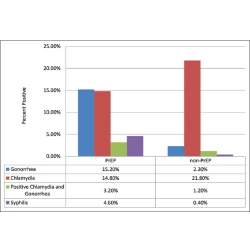
Background and Objective: Pre-exposure prophylaxis (PrEP) effectively prevents the spread of the human immunodeficiency virus (HIV). HIV is a disease primarily contracted by men who have sex with men or the sharing of needles, syringes, and other drug injection equipment. However, there are some disparities over the thought that PrEP patients have a disproportionate incidence of sexually transmitted infections (STIs) compared with non-PrEP patients. This study aims to clarify the disparity and identify if PrEP patients have a higher incidence of STIs. Methods: A survey of 143 respondents was conducted on STI incidence, risk factors, and abstinence from May 13, 2022, to June 20, 2022. The results were analyzed in Statistical Package for the Social Sciences (SPSS V28.0.0.0). SPSS was used to analyze the descriptive statistics associated with STI data obtained from the Naval Medical Readiness and Training Command, Camp Lejeune, Community Health Clinic Patient and Laboratory Tracker. Results: This study found a higher incidence of STIs among PrEP patients than non-PrEP patients and a statistical significance (p = 0.010) between the number of partners a person had sex with over the past year and the lifetime incidence of STIs. Portions of the data in the linear regression were used to calculate the significance and can be used as a predictor of STIs based on the number of partners a person has. This can help patients within this community understand their actual risk of contracting an STI based on a potential risk factor. Conclusion and Implications for Translation: This study found a higher incidence of STIs among PrEP patients than non-PrEP patients. Additionally, the study can help public health professionals understand the risks associated with military patients who take PrEP and target specific risk factors that influence the disparity in the incidence of STIs. Future studies may use survey data from this study to understand the implications of other risk factors and their association with STIs. Public health professionals can also use these data to develop a predictive index for many risk factors. A predictive index on STI risk is an extremely valuable tool as it allows users to view their risk of obtaining an STI.
Downloads
Similar Articles
- George Ikpe, Juliet Enukeme, Chukwuemeka Amuta, Ikenna Nwakanma, Orieji Agomoh, Okwudili Chukwudinma, Chioma Ukanwa, Peter Nwaokenneya, Advanced HIV Disease among Persons Newly Diagnosed with HIV: A Hospital-Based Study in Abia State, Nigeria , Vol. 9 No. Continuous (2025): The International Journal of Translational Medical Research and Public Health (IJTMRPH)
- Ikenna J Nwakamma, Carol S Talla, Stephanie E Kei, Genevieve C Okoro, Godwin Asuquo, Kema A Onu, Adolescent and Young People’s Utilization of HIV/Sexual and Reproductive Health Services: Comparing Health Facilities and Mobile Community Outreach Centers , Vol. 3 No. 2 (2019): The International Journal of Translational Medical Research and Public Health (IJTMRPH)
- Ahmad Bashir Umar, Mohammed Kabir Saleh, Yahuza Mansur Adamu, Sadiq Hassan, Muktar Hassan Aliyu, Anas Ismail, Ocular Health Complications Among People Living with HIV/AIDS in Nigeria: Leveraging Doppler Ultrasonography to Identify and Manage Risk Factors , Vol. 9 No. Continuous (2025): The International Journal of Translational Medical Research and Public Health (IJTMRPH)
- Lillian Lamba, Eustarckio Kazonga, Christopher Nyirenda, Rodgers Chilyabanyama, Viral Load Suppression Among Adults with HIV on Antiretroviral Therapy: Outcomes from a Lusaka District Hospital, Zambia , Vol. 9 No. Continuous (2025): The International Journal of Translational Medical Research and Public Health (IJTMRPH)
- Ekidor Ateyo Lokorio, Isaac Mwanzo, Gordon Ogweno, Voluntary Medical Male Circumcision Services and Related Psychosocial Factors Among Men in Kenya , Vol. 8 No. Continuous (2024): The International Journal of Translational Medical Research and Public Health (IJTMRPH)
- Harlem J Gunness, Striking Differences in Physical and Mental/Behavioral Health Status Between Homeless Bisexual and Gay Young Men in New York City, United States , Vol. 4 No. 1 (2020): The International Journal of Translational Medical Research and Public Health (IJTMRPH)
- John A Markson, Early Infant Diagnosis of HIV in Primary Health Care Centers , Vol. 5 No. 1 (2021): The International Journal of Translational Medical Research and Public Health (IJTMRPH)
- Emmanuel Nwanya, Evangeline T Oparaocha, Book of Abstracts: 4th International Congress on Health Sciences and Technology Organized by the School of Health Technology, Federal University of Technology (FUTO), Owerri, Imo State, Nigeria, 7-9 August, 2019 , Vol. 3 No. S1 (2019): The International Journal of Translational Medical Research and Public Health (IJTMRPH)
- Caroline Mtaita, Samuel Likindikoki, Shishira Mnjokava, Gaspar Mbita, Elvis Safary, Dawud Hilliard, Albrecht Jahn, Accessibility to Gender-based Violence Health Services for Adolescent Girls and Young Women in Tanzania , Vol. 5 No. 2 (2021): The International Journal of Translational Medical Research and Public Health (IJTMRPH)
- Esther Ayaaba, Yi Liu, Yan Li, Lei Han, Quansah Dan Yedu, Ni Chunhu, Measures to Control the Prevalence of Pneumoconiosis in Coal Mining: A Review of the Literature , Vol. 1 No. 1 (2017): The International Journal of Translational Medical Research and Public Health (IJTMRPH)
<< < 1 2 3 4 5 6 7 8 9 10 > >>
You may also start an advanced similarity search for this article.
Published
How to Cite
Issue
Section
License
Copyright © 2023 Nicholas A Sleeman, Carol Hoban, Samer Koutoubi. Published by Global Health and Education Projects, Inc., USA.

This is an open-access article distributed under the terms of the Creative Commons Attribution-NonCommercial-ShareAlike 4.0 International License , which permits others to remix, transform, and build upon the work non-commercially, provided the original author is credited and the new creations are licensed under the same terms.



 .
.

