
Network Pharmacology and Preliminary in Vitro Evaluation of Piper longum (Indian Long Pepper) in Breast Cancer
DOI:
https://doi.org/10.21106/IJTMRPH_266_2026Keywords:
- Breast Cancer,
- Piper Longum,
- Network Pharmacology,
- Molecular Docking,
- Cell Proliferation
Abstract
Background and Objectives: Piper longum (Indian Long Pepper) contains phytochemicals reported to have anticancer activity, but their targets and effects in breast-cancer models remain uncertain. This exploratory study combined network pharmacology, analysis of public breast cancer data, molecular docking, MCF-7 viability, DNA cell cycle, and apoptosis assays.
Methods: Nineteen compounds from P. longum fruit were identified using the literature and phytochemical databases. Target prediction tools and cancer gene databases were used to identify interactions with breast cancer genes. Protein–protein interaction, gene ontology, and pathway analyses highlighted key targets. Molecular docking was used to evaluate binding affinities, and in vitro assays assessed cytotoxicity in MCF-7 breast cancer cells.
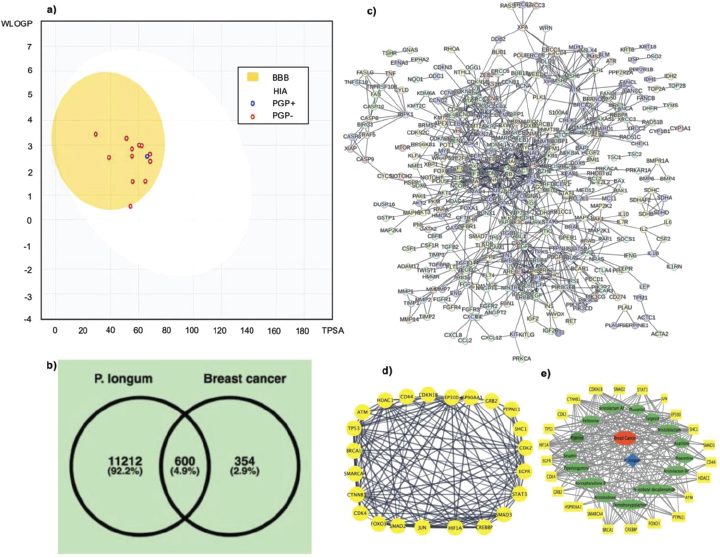
Results: This study revealed 600 common gene targets between P. longum compounds and breast cancer. Compound-target-disease network analysis prioritized Norcepharadione B, Aristolodione, Pellitorine, Aristolactam AII, and N-isobutyl decadienamide as candidate compounds. Significant breast cancer genes (TP53, CTNNB1, STAT3, SMAD3, EGFR, and HSP90AA1) were central to these interactions. Notably, HSP90AA1 showed the most favorable predicted docking scores with Norcepharadione B and Aristolactam AII. Additionally, the aqueous extract of P. longum significantly inhibited the MCF-7 MTT signal, with an IC50 of 3.75 μg/mL.
Conclusion and Implications for Translation: In this study, Piper longum phytochemicals were linked to key cancer genes. Molecular docking of the top five compounds with six genes showed that Norcepharadione B had the strongest affinity for HSP90AA1, indicating its potential to modulate HSP90AA1-mediated pathways, including ER and HER2 signaling. These interactions suggest therapeutic relevance. Furthermore, aqueous P. longum extract inhibited MCF-7 cellular metabolism at the IC₅₀ dose, possibly through cell-cycle arrest or apoptosis, which is currently under further investigation in our laboratory. These findings support further testing of defined P. longum compounds in breast-cancer models, but they do not yet establish therapeutic activity or mechanism.
Downloads
Similar Articles
- María G Ramírez-Rojas, María G Freyermuth-Enciso, María B Duarte-Gómez, Defragmenting the Health Care System in Mexico: Universal Access for Obstetric Emergencies , Vol. 4 No. 1 (2020): The International Journal of Translational Medical Research and Public Health (IJTMRPH)
- Ashok Bahadur Varma, Can the Internal Nasal Valves Method Be a Game Changer for Preventing Respiratory Tract Infections? , Vol. 8 No. Continuous (2024): The International Journal of Translational Medical Research and Public Health (IJTMRPH)
- Anushka Banerjee, Abhijit G. Banerjee, Chronic Inflammation in Polycystic Ovarian Syndrome: Examining Biomarker–Driven Control Strategies to Reduce Population–Level Disease Burden , Vol. 8 No. Continuous (2024): The International Journal of Translational Medical Research and Public Health (IJTMRPH)
- Deepa Dongarwar, Karla Moriel, Kobby A Wiafe, Hamisu M Salihu, Sex and Age-Based Differences in Adult Acute Myeloid Leukemia Hospitalizations in the United States, 2009-2018 , Vol. 6 No. 1 (2022): The International Journal of Translational Medical Research and Public Health (IJTMRPH)
- Nasir Ilyas, Romuladus E Azuine, Alina Tamiz, COVID-19 Pandemic in Pakistan , Vol. 4 No. 1 (2020): The International Journal of Translational Medical Research and Public Health (IJTMRPH)
- Laura Elisabeth Gressler, Andrej Radoja, Terrie Cowley, Deanne Clare, John Kusiak, Allen Cowley, Temporomandibular Disorders at a Crossroads: Meeting Summary , Vol. 9 No. Special Collection (2025): The International Journal of Translational Medical Research and Public Health (IJTMRPH)
- Amina P Alio, Linxi Liu, Kelly Thevenet-Morrison, Michelle R Rubado, Hugh F Crean, Peter J Veazie, Christopher L Seplaki, Ann Dozier, Association of Voluntary Legal Paternity and Breastfeeding Duration and Exclusivity in a Sample of Mothers in NewYork State, United States , Vol. 5 No. 2 (2021): The International Journal of Translational Medical Research and Public Health (IJTMRPH)
- Vinod K Ramani, Radheshyam Naik, A Narrative Review of the Pathophysiology of Mucormycosis Infection Among COVID-19 Patients in India: Epidemiology and Clinical Implications , Vol. 6 No. 1 (2022): The International Journal of Translational Medical Research and Public Health (IJTMRPH)
- Caroline Okeke, Evangeline T Oparaocha, Book of Abstracts: 3rd International Congress on Health Sciences and Technology, School of Health Technology, Federal University of Technology Owerri, Nigeria, 8-11 August, 2018 , Vol. 2 No. S1 (2018): The International Journal of Translational Medical Research and Public Health (IJTMRPH)
- Gopal K Singh, Mehrete Girmay, Michelle Allender, Christine T Ramey, Digital Divide: Marked Disparities in Computer and Broadband Internet Use and Associated Health Inequalities in the United States , Vol. 4 No. 1 (2020): The International Journal of Translational Medical Research and Public Health (IJTMRPH)
You may also start an advanced similarity search for this article.
Published
How to Cite
Issue
Section
License
Copyright © 2026 Shivam Singh, Ashok Sharma, Richa Tripathi, Vitthal Govindappa Huddar, Subhash Gupta. Published by Global Health and Education Projects, Inc., USA.

This is an open-access article distributed under the terms of the Creative Commons Attribution-NonCommercial-ShareAlike 4.0 International License , which permits others to remix, transform, and build upon the work non-commercially, provided the original author is credited and the new creations are licensed under the same terms.



 .
.

