
Contact Lens Use and Prescribing Trends in Suburban Selangor, Malaysia: A Retrospective Study
DOI:
https://doi.org/10.21106/IJTMRPH_69_2025Keywords:
- Contact lenses,
- disposable contact lenses,
- prescription,
- suburban,
- optometry
Abstract
Background and Objective: Contact lens use is an increasingly common vision care practice worldwide, offering convenience and aesthetic appeal. However, inappropriate prescribing and unsafe use of contact lenses are associated with ocular complications, making this an important public health issue. Understanding prescribing patterns within specific populations can provide valuable insights to promote safe lens use and prevent avoidable eye health problems. Therefore, this study aims to investigate the prescription trends of disposable soft contact lenses in selected suburban areas of Selangor, Malaysia.
Methods: A retrospective review of 396 disposable contact lens prescriptions from 10 optometry clinics was conducted from January 2019 to December 2020. Data on demographic characteristics and contact lens criteria (modality, design, material, and water content) were extracted.
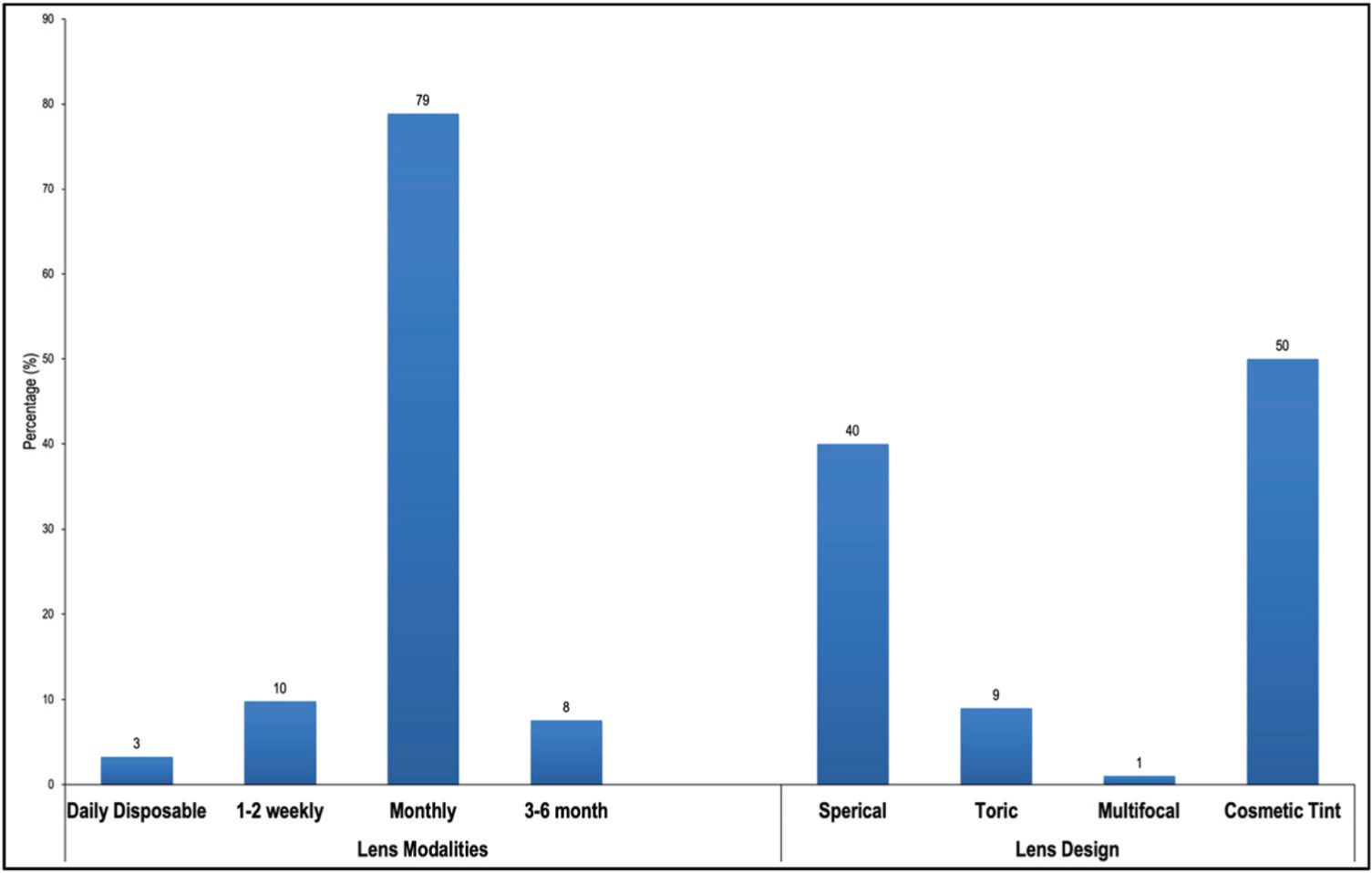
Results: Descriptive statistics were used to summarize the prescription patterns. The mean age of contact lens wearers was 25.3 } 9.7 years, with a female predominance (87%). Monthly disposable lenses were most frequently prescribed (79%), followed by 1–2-week (10%) and 3–6-month lenses (8%). Daily disposable lenses accounted for only 3%. Cosmetic tinted lenses dominated design preferences (50%), followed by spherical lenses (40%). Hydrogel lenses were prescribed more often (64%) than silicone hydrogel (36%). Nearly equal distribution was observed for low- and medium-water content (46% and 45%, respectively).
Conclusion and Implications for Translation: Suburban prescribing trends are strongly influenced by affordability and aesthetics, with young women representing the largest consumer group. However, the low uptake of daily disposables and the widespread use of cosmetic lenses raise concerns about ocular safety and potential public health risks. These findings may suggest potential value in community-based education on safe lens practices, regulatory oversight of cosmetic lens sales, and strategies to improve equitable access to safer contact lens options.
Downloads
Similar Articles
- Musa Baba Maiyaki, Garba Dahiru, Amina Abdullahi, Tijjani Hussaini, Sabitu Shuaibu, Mohammed Auwal Ibrahim, Auwal Adamu, Nura Mohammed, Mahmoud Habib Maje, Hamisu M Salihu, Profiles and Characteristics of Patients with Mild to Moderate COVID -19 Disease Phenotypes in a Teaching Hospital in Kano, Northern Nigeria , Vol. 6 No. 1 (2022): The International Journal of Translational Medical Research and Public Health (IJTMRPH)
- Musa M Dogara, Saadatu Ahmad, Babalola J Balogun, Salwa S Dawaki, Muzammil B Mustapha, Aminu U Abdurrahman, Lawal Bala, Abubakar Zakari, David U Livingstone, Schistosomiasis and Associated Risk Factors Among School-Aged Children in Northern Nigeria , Vol. 4 No. 2 (2020): The International Journal of Translational Medical Research and Public Health (IJTMRPH)
- Elizabeth Armstrong-Mensah, Ato Kwamena Tetteh, Gifty Rhodalyn Tetteh, COVID-19 Pandemic: Face Mask Mandates, Hospitalization, and Infection Rates in the United States , Vol. 5 No. 2 (2021): The International Journal of Translational Medical Research and Public Health (IJTMRPH)
- Sitratullah O Maiyegun, Korede K Yusuf, Deepa Dongarwar, Sahra Ibrahimi, Chioma Ikedionwu, Hamisu M Salihu, COVID-19: How Can Doulas Support Pandemic Control? , Vol. 5 No. 2 (2021): The International Journal of Translational Medical Research and Public Health (IJTMRPH)
- Abhijit Dey, Rajat Basu, Poulami Basu, Simran Keshri, Bandita Sengupta, Sandip Roy, Prevention Versus Treatment: Barriers to Tuberculosis Prevention and Treatment in Urban Areas , Vol. 9 No. Continuous (2025): The International Journal of Translational Medical Research and Public Health (IJTMRPH)
- Bashir Faiza, Hassan Mehmood, Sumera Naz, Saima Naz, Prevalence and Determinants of Substance Abuse Among Slum Dwellers in Islamabad- Pakistan , Vol. 3 No. 2 (2019): The International Journal of Translational Medical Research and Public Health (IJTMRPH)
- Caroline Okeke, Evangeline T Oparaocha, Book of Abstracts: 3rd International Congress on Health Sciences and Technology, School of Health Technology, Federal University of Technology Owerri, Nigeria, 8-11 August, 2018 , Vol. 2 No. S1 (2018): The International Journal of Translational Medical Research and Public Health (IJTMRPH)
- Japhet Adeniran Olugbogi, Saheed Akinmayowa Lawal, Oluwaseyi Senapon Babatunde, Evaluation of Access, Satisfaction and Perceived Quality of a Free Community Medical Outreach in Badagry, Lagos, Southwest Nigeria , Vol. 10 (2026): The International Journal of Translational Medical Research and Public Health (IJTMRPH)
- Adrian H.P. Palmer, Physiotherapy – An Effective but Underutilized Strategy for Strengthening Public Health , Vol. 9 No. Continuous (2025): The International Journal of Translational Medical Research and Public Health (IJTMRPH)
- Peter Chilipweli, Given Mwambope, Abubakar O. Abdallah, Patrick Mwakubo, Aneth Dunia, Compliance, Barriers, and Enhancers of WHO “Five Moments for Hand Hygiene” Among Healthcare Workers in Tanzania , Vol. 9 No. Continuous (2025): The International Journal of Translational Medical Research and Public Health (IJTMRPH)
You may also start an advanced similarity search for this article.
Published
How to Cite
Issue
Section
License
Copyright © 2026 Nur Ikazareen Dahlan, Nor Shahrul Nizam Muhamad Nor, Firdaus Yusof, Noor Halilah Buari. Published by Global Health and Education Projects, Inc., USA.

This is an open-access article distributed under the terms of the Creative Commons Attribution-NonCommercial-ShareAlike 4.0 International License , which permits others to remix, transform, and build upon the work non-commercially, provided the original author is credited and the new creations are licensed under the same terms.



 .
.

