
Building Real-World Evidence Infrastructure to Improve Health and Healthcare in the United States: Part II—How Coordinated Registry Networks Operate Like Systemic Coordinated Inter-Organizational Networks
DOI:
https://doi.org/10.25259/IJTMRPH_75_2024Keywords:
- Evidence-Based Medicine,
- Learning Social Theory,
- Public Health,
- Public Reporting of Healthcare Data,
- Quality Improvement,
- Registries
Abstract
Background and Objective: Coordinated Registry Networks (CRNs) are networks of healthcare partners that create and utilize information from clinical society registries and other sources to drive evidence-based improvements in healthcare. In Part I of this three-part series, we introduced the systemic coordinated interorganizational networks (SCIONs) theory, which is proposed as a unique mode of societal coordination that fosters trust, cooperation, and adaptability among partner organizations to address complex societal problems, including healthcare. In this article, we analyze how CRNs function like SCIONs to better understand how CRNs can promote innovation to improve outcomes, quality, and efficiency.
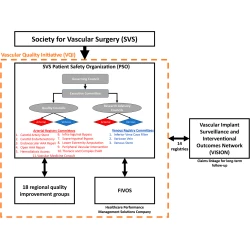
Methods: The SCIONs theory is used to describe the structure and functions of CRNs and to consider how they might be optimized in practice. We apply the SCIONs theory to an extended case study of the Society for Vascular Surgery (SVS) Vascular Quality Initiative (VQI) to describe the structure and functions of this CRN.
Results: The criteria to identify SCIONs—characteristics, modes of coordination, and performance evaluation— are applied to the VQI as CRN (and to the VQI as an extended case study). CRNs may drive radical innovation in quality improvement, research, regulatory decision-making, and medical product development. The consequences of these innovations in vascular surgery have been measured by reduced patient stays, reduced barriers in care access, and improved care quality metrics. A partnership between the SVS VQI and the Medical Device Epidemiology Network further expanded VQI’s capabilities and integrated Medicare data for a robust evaluation of patient outcomes. Key factors making innovation possible include regional sub-networks, collaborative stakeholder relationships, and a dedicated network-coordinating organization that provides technical expertise, leadership, and data quality assurance for effective collaboration.
Conclusion and Implications for Translation: The description of the VQI as a SCION offers a generalizable model for the CRN as real-world data collection and analysis that has transformed healthcare delivery and improved patient outcomes at scale. The CRN model is proposed for development broadly across medical and surgical specialties in the US as well as primary care.
Downloads
Most read articles by the same author(s)
- Osman Nuri Yogurtcu, Laura E. Gressler, Jens Eldrup-Jorgensen, Kashif Haqqi, Colin Shepard, Orestis A. Panagiotou, Santiago J. Molina, Philip P. Goodney, Ali B. Abbasi, Brian S. Anderson, Wilbur C. Hadden, James E. Tcheng, Julia Skapik, Gregory Pappas, Building Real-World Evidence Infrastructure to Improve Health and Healthcare in the United States: Part I—Coordinated Registry Networks and Systemic Coordinated Inter-Organizational Networks , International Journal of Translational Medical Research and Public Health: Vol. 9 No. Special Collection (2025): The International Journal of Translational Medical Research and Public Health (IJTMRPH)
- Osman Nuri Yogurtcu, Laura E Gressler, Jens Eldrup-Jorgensen, Kashif Haqqi, Colin Shepard, Orestis A Panagiotou, Santiago J Molina, Philip P Goodney, Ali B Abbasi, Brian S Anderson, Wilbur C Hadden, James E Tcheng, Julia Skapik, Gregory Pappas, Building Real-World Evidence Infrastructure to Improve Health and Healthcare in the United States: Part III— Questions for Translational Science and Action Theory , International Journal of Translational Medical Research and Public Health: Vol. 9 No. Special Collection (2025): The International Journal of Translational Medical Research and Public Health (IJTMRPH)
- Gregory Pappas, Introduction to Special Collection: Building the Real-World Evidence Infrastructure to Accelerate Innovation and Improve Outcomes in Healthcare , International Journal of Translational Medical Research and Public Health: Vol. 9 No. Special Collection (2025): The International Journal of Translational Medical Research and Public Health (IJTMRPH)
Similar Articles
- Albert Apotele Nyaaba, Augustine Tanle, Louis Kobina Dadzie, Matthew Ayamga, Determinants of Under-Five Mortality in Ghana: Evidence from the Ghana Demographic and Health Survey , Vol. 4 No. 2 (2020): The International Journal of Translational Medical Research and Public Health (IJTMRPH)
- Bright Opoku Ahinkorah, Abdul-Aziz Seidu, Eugene Budu, Ebenezer Kwesi Armah-Ansah, Ebenezer Agbaglo, Collins Adu, Edward Kwabena Ameyaw, Sanni Yaya, Factors Associated with Utilization of Postnatal Care Services in Mali, West Africa Bright Opoku Ahin , Vol. 5 No. 1 (2021): The International Journal of Translational Medical Research and Public Health (IJTMRPH)
- Elizabeth A Armstrong-Mensah, Transitioning a Public Health Study Abroad Program to Virtual Format During the COVID-19 Pandemic: Implications for Public Health Practice , Vol. 6 No. 1 (2022): The International Journal of Translational Medical Research and Public Health (IJTMRPH)
- Mehrete Girmay, Gopal K Singh, Social Isolation, Loneliness, and Mental and Emotional Well-being among International Students in the United States , Vol. 3 No. 2 (2019): The International Journal of Translational Medical Research and Public Health (IJTMRPH)
- Romuladus E Azuine, Gopal K Singh, Shanita D Williams, Evangeline T Oparaocha, Shiv C Mathur, Translating Public and Population Health Research into Policy and Actions: The International Journal of Translational Medical Research and Public Health (IJTMRPH) , Vol. 1 No. 1 (2017): The International Journal of Translational Medical Research and Public Health (IJTMRPH)
- María G Ramírez-Rojas, María G Freyermuth-Enciso, María B Duarte-Gómez, Defragmenting the Health Care System in Mexico: Universal Access for Obstetric Emergencies , Vol. 4 No. 1 (2020): The International Journal of Translational Medical Research and Public Health (IJTMRPH)
- Peter Chilipweli, Given Mwambope, Abubakar O. Abdallah, Patrick Mwakubo, Aneth Dunia, Compliance, Barriers, and Enhancers of WHO “Five Moments for Hand Hygiene” Among Healthcare Workers in Tanzania , Vol. 9 No. Continuous (2025): The International Journal of Translational Medical Research and Public Health (IJTMRPH)
- Adrian H.P. Palmer, Physiotherapy – An Effective but Underutilized Strategy for Strengthening Public Health , Vol. 9 No. Continuous (2025): The International Journal of Translational Medical Research and Public Health (IJTMRPH)
- Laura Elisabeth Gressler, Andrej Radoja, Terrie Cowley, Deanne Clare, John Kusiak, Allen Cowley, Temporomandibular Disorders at a Crossroads: Meeting Summary , Vol. 9 No. Special Collection (2025): The International Journal of Translational Medical Research and Public Health (IJTMRPH)
- Lauren E Gibson, Albert Adusei Dua, Jake W Coldiron, Amanda S Peters, Sushana Lamsal, Grace-Elizabeth A Edeh, Destiny Masha, Elizabeth A Armstrong-Mensah, Individual and Community Level Factors Related to Contraceptive Access, Family Planning, and Reproductive Health Challenges Among Women in Kumasi, Ghana: A Field Study , Vol. 6 No. 1 (2022): The International Journal of Translational Medical Research and Public Health (IJTMRPH)
<< < 1 2 3 4 5 6 7 8 9 10 > >>
You may also start an advanced similarity search for this article.
Published
How to Cite
Issue
Section
License
Copyright © 2025 Osman Nuri Yogurtcu, Laura E. Gressler, Jens Eldrup-Jorgensen, Kashif Haqqi, Colin Shepard, Orestis A. Panagiotou, Santiago J. Molina, Philip P. Goodney, Ali B. Abbasi, Brian S. Anderson, Wilbur C. Hadden, James E. Tcheng, Julia Skapik, Gregory Pappas. Published by Global Health and Education Projects, Inc., USA.

This is an open-access article distributed under the terms of the Creative Commons Attribution-NonCommercial-ShareAlike 4.0 International License , which permits others to remix, transform, and build upon the work non-commercially, provided the original author is credited and the new creations are licensed under the same terms.



 .
.

