
Building Real-World Evidence Infrastructure to Improve Health and Healthcare in the United States: Part III— Questions for Translational Science and Action Theory
DOI:
https://doi.org/10.25259/IJTMRPH_76_2024Keywords:
- Evidence-Based Medicine,
- Learning Health System,
- Public Health,
- Registries
Abstract
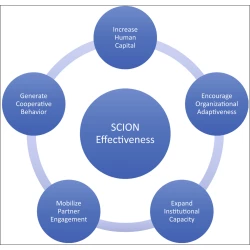
Background and Objective: Previous work in this series has introduced real-world evidence (RWE), coordinated registry networks (CRNs), and systemic, coordinated, inter-organizational networks (SCIONs) theory. The application of SCIONs theory to CRNs illuminates how their structure and function foster trust and cooperation in a network of organizations to successfully address complex problems in healthcare. This third part in the series asks questions about how SCIONs theory can benefit CRNs and how the experience of CRNs can further develop the SCIONs theory. Methods: This manuscript analyzes reciprocal relationships related to SCIONs theory and CRN practice, examining how each can be used to benefit the other. While SCIONs theory has not yet formally been used to direct the development of a CRN, future application is proposed. Conversely, we explored how the practical experiences of CRNs can inform and refine our understanding of SCIONs, including identifying areas for theoretical development and through an exploration of the current limitations of CRNs. Results: The SCIONs theory may usefully direct CRN development in key leadership areas, including increasing human capital, encouraging organizational adaptiveness, expanding institutional capacity, mobilizing political engagement, and generating cooperative behavior. CRNs, guided by SCIONs theory, can offer a pathway towards a more efficient, equitable, and learning-oriented healthcare system. A comprehensive approach proposed for CRNs may facilitate the expansion of the evaluation component in SCIONs theory. Conclusion and Implications for Translation: CRN program managers should prioritize strategic approaches that foster human capital, organizational adaptability, and institutional capacity. Government agencies may consider investments in CRN as a way to build RWE infrastructure that improves quality and efficiency of healthcare broadly. Public discourse may benefit from a clearer understanding of the role of cooperation in society to address issues that government and markets are not well suited to address. The literature on SCIONs can support the non-profit literature in the way the business literature supports the for-profit sector.
Downloads
Most read articles by the same author(s)
- Osman Nuri Yogurtcu, Laura E. Gressler, Jens Eldrup-Jorgensen, Kashif Haqqi, Colin Shepard, Orestis A. Panagiotou, Santiago J. Molina, Philip P. Goodney, Ali B. Abbasi, Brian S. Anderson, Wilbur C. Hadden, James E. Tcheng, Julia Skapik, Gregory Pappas, Building Real-World Evidence Infrastructure to Improve Health and Healthcare in the United States: Part I—Coordinated Registry Networks and Systemic Coordinated Inter-Organizational Networks , International Journal of Translational Medical Research and Public Health: Vol. 9 No. Special Collection (2025): The International Journal of Translational Medical Research and Public Health (IJTMRPH)
- Osman Nuri Yogurtcu, Laura E. Gressler, Jens Eldrup-Jorgensen, Kashif Haqqi, Colin Shepard, Orestis A. Panagiotou, Santiago J. Molina, Philip P. Goodney, Ali B. Abbasi, Brian S. Anderson, Wilbur C. Hadden, James E. Tcheng, Julia Skapik, Gregory Pappas, Building Real-World Evidence Infrastructure to Improve Health and Healthcare in the United States: Part II—How Coordinated Registry Networks Operate Like Systemic Coordinated Inter-Organizational Networks , International Journal of Translational Medical Research and Public Health: Vol. 9 No. Special Collection (2025): The International Journal of Translational Medical Research and Public Health (IJTMRPH)
- Gregory Pappas, Introduction to Special Collection: Building the Real-World Evidence Infrastructure to Accelerate Innovation and Improve Outcomes in Healthcare , International Journal of Translational Medical Research and Public Health: Vol. 9 No. Special Collection (2025): The International Journal of Translational Medical Research and Public Health (IJTMRPH)
Similar Articles
- Elizabeth Armstrong Mensah, Maria Adjini, Bria Pringle-Weston, Akwasi Akosah, Rachael Addo, Late Dementia Diagnosis Among Elderly Minority Populations in the United States: Causes, Effects, and Addressing Inequities , Vol. 8 No. Continuous (2024): The International Journal of Translational Medical Research and Public Health (IJTMRPH)
- Nicholas A Sleeman, Carol Hoban, Samer Koutoubi, Sexually Transmitted Infections in Pre-Exposure Prophylaxis Patients , Vol. 7 No. 2 (2023): The International Journal of Translational Medical Research and Public Health (IJTMRPH)
- Elisa J. Gordon, Zubairu Iliyasu, Elizabeth S. Rose, Fatimah I. Tsiga-Ahmed, Usman J. Wudil, Aishatu L. Adamu, C. William Wester, Muktar H. Aliyu, Building Capacity for the Ethical Conduct of Genetic and Genomic Research in Nigeria: The Vanderbilt-Nigeria Research Ethics Training Program , Vol. 9 No. Continuous (2025): The International Journal of Translational Medical Research and Public Health (IJTMRPH)
- Tukur Dahiru, Awawu G Nmadu, Adegboyega M Oyefabi, Clement Woje, Bilkisu Nwankwo, Zainab K Muhammad-Idris, Levels, Trends, and Causes of Adolescent and Young Adult Maternal Mortality in Nigeria During 1990–2017: Analysis of the 2017 Global Burden of Disease Study Database , Vol. 6 No. 2 (2022): The International Journal of Translational Medical Research and Public Health (IJTMRPH)
- Sitratullah O Maiyegun, Korede K Yusuf, Deepa Dongarwar, Sahra Ibrahimi, Chioma Ikedionwu, Hamisu M Salihu, COVID-19: How Can Doulas Support Pandemic Control? , Vol. 5 No. 2 (2021): The International Journal of Translational Medical Research and Public Health (IJTMRPH)
- Peter Chilipweli, Given Mwambope, Abubakar O. Abdallah, Patrick Mwakubo, Aneth Dunia, Compliance, Barriers, and Enhancers of WHO “Five Moments for Hand Hygiene” Among Healthcare Workers in Tanzania , Vol. 9 No. Continuous (2025): The International Journal of Translational Medical Research and Public Health (IJTMRPH)
- Lillian Lamba, Eustarckio Kazonga, Christopher Nyirenda, Rodgers Chilyabanyama, Viral Load Suppression Among Adults with HIV on Antiretroviral Therapy: Outcomes from a Lusaka District Hospital, Zambia , Vol. 9 No. Continuous (2025): The International Journal of Translational Medical Research and Public Health (IJTMRPH)
- Dania Matta, Patti Herring, W. Lawrence Beeson, Seth Wiafe, The Role of Perceived Susceptibility, Perceived Severity, Perceived Barriers and Benefits in COVID-19 Vaccine Hesitancy and Uptake Among Outpatient Surgery Nurses in the United States: A Qualitative Study , Vol. 7 No. 1 (2023): The International Journal of Translational Medical Research and Public Health (IJTMRPH)
- Abhijit Dey, Rajat Basu, Poulami Basu, Simran Keshri, Bandita Sengupta, Sandip Roy, Prevention Versus Treatment: Barriers to Tuberculosis Prevention and Treatment in Urban Areas , Vol. 9 No. Continuous (2025): The International Journal of Translational Medical Research and Public Health (IJTMRPH)
- Ashok Bahadur Varma, Can the Internal Nasal Valves Method Be a Game Changer for Preventing Respiratory Tract Infections? , Vol. 8 No. Continuous (2024): The International Journal of Translational Medical Research and Public Health (IJTMRPH)
<< < 2 3 4 5 6 7 8 9 10 11 > >>
You may also start an advanced similarity search for this article.
Published
How to Cite
Issue
Section
License
Copyright © 2025 Osman Nuri Yogurtcu, Laura E Gressler, Jens Eldrup-Jorgensen, Kashif Haqqi, Colin Shepard, Orestis A Panagiotou, Santiago J Molina, Philip P Goodney, Ali B Abbasi, Brian S Anderson, Wilbur C Hadden, James E Tcheng, Julia Skapik, Gregory Pappas. Published by Global Health and Education Projects, Inc., USA.

This is an open-access article distributed under the terms of the Creative Commons Attribution-NonCommercial-ShareAlike 4.0 International License , which permits others to remix, transform, and build upon the work non-commercially, provided the original author is credited and the new creations are licensed under the same terms.



 .
.

