
Building Capacity for the Ethical Conduct of Genetic and Genomic Research in Nigeria: The Vanderbilt-Nigeria Research Ethics Training Program
DOI:
https://doi.org/10.25259/IJTMRPH_95_2024Keywords:
- Capacity Building,
- Global Health,
- Institutional Review Board,
- International,
- Precision Medicine,
- Research Ethics
Abstract
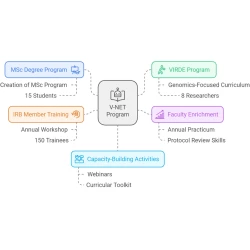
Background and Objective: The Vanderbilt-Nigeria Research Ethics Training Program (V-NET) is an innovative research ethics training program that aims to address the increasing demand for research in precision medicine in Africa by building capacity for the ethical design, conduct, and oversight of genetic and genomic research in Nigeria.
Methods: The program includes creation of a Master of Science (MSc) degree program in research ethics, training of 15 MSc students, and the integration of a genomics-focused ethics curriculum into a faculty enrichment program at Vanderbilt University Medical Center (VUMC), benefiting eight Nigerian researchers over 5 years. Twelve Nigerian Institutional Review Board (IRB) members will participate in a practicum at VUMC to enhance their skills in protocol review and administrative procedures. Other capacity-building activities include an annual workshop for IRB members in Nigeria on the protection of human subjects in research, responsible conduct of research, ethics of genetic/genomic research, and review of genomic research protocols (~150 trainees), and the creation of a curricular toolkit in ethics of genetic/genomic research tailored to Nigerian IRB members, in addition to quarterly webinars.
Results: V-NET will equip a group of Nigerian scientists with advanced skills, positioning them as leaders in the ethical design and review of genetic and genomic research within Nigeria’s dynamic research environment.
Conclusion and Implications for Translation: Research ethics training programs are essential for strengthening the ethical design and implementation of clinical and translational research, particularly in low- and middleincome countries.
Downloads
Most read articles by the same author(s)
- Muktar H Aliyu, Mahmoud U Sani, Donna J Ingles, Fatima I. T siga-Ahmed, Baba M Musa, M. Shannon Byers, Deepa Dongarwar, Hamisu M Salihu, C. William Wester, Building Physician-Scientist Skills in R Programming: A Short Workshop Report , International Journal of Translational Medical Research and Public Health: Vol. 6 No. 1 (2022): The International Journal of Translational Medical Research and Public Health (IJTMRPH)
- Fatima Usman, Zubairu Iliyasu, Hamisu M Salihu, Muktar H Aliyu, COVID-19 Pandemic and Medical Education in Nigeria , International Journal of Translational Medical Research and Public Health: Vol. 5 No. 2 (2021): The International Journal of Translational Medical Research and Public Health (IJTMRPH)
Similar Articles
- Deepa Dongarwar, Brisa Y Garcia, Sitratullah O Maiyegun, Korede K Yusuf, Hamisu M Salihu, COVID-19 Early Vaccination Rates and Gross Domestic Product Per Capita , Vol. 5 No. 1 (2021): The International Journal of Translational Medical Research and Public Health (IJTMRPH)
- Judith Eberhardt, Jonathan Ling, A Qualitative Exploration of Perceptions of the COVID-19 Vaccine in the United Kingdom During the Later Stages of the Vaccine Rollout , Vol. 6 No. 1 (2022): The International Journal of Translational Medical Research and Public Health (IJTMRPH)
- George Ikpe, Juliet Enukeme, Chukwuemeka Amuta, Ikenna Nwakanma, Orieji Agomoh, Okwudili Chukwudinma, Chioma Ukanwa, Peter Nwaokenneya, Advanced HIV Disease among Persons Newly Diagnosed with HIV: A Hospital-Based Study in Abia State, Nigeria , Vol. 9 No. Continuous (2025): The International Journal of Translational Medical Research and Public Health (IJTMRPH)
- Musa Baba Maiyaki, Garba Dahiru, Amina Abdullahi, Tijjani Hussaini, Sabitu Shuaibu, Mohammed Auwal Ibrahim, Auwal Adamu, Nura Mohammed, Mahmoud Habib Maje, Hamisu M Salihu, Profiles and Characteristics of Patients with Mild to Moderate COVID -19 Disease Phenotypes in a Teaching Hospital in Kano, Northern Nigeria , Vol. 6 No. 1 (2022): The International Journal of Translational Medical Research and Public Health (IJTMRPH)
- Ashok Bahadur Varma, Can the Internal Nasal Valves Method Be a Game Changer for Preventing Respiratory Tract Infections? , Vol. 8 No. Continuous (2024): The International Journal of Translational Medical Research and Public Health (IJTMRPH)
- Marilyn Murrillo, On Utilizing Artificial Intelligence to Impact Healthcare in Low-Income Countries , Vol. 8 No. Continuous (2024): The International Journal of Translational Medical Research and Public Health (IJTMRPH)
- Anna Kallasidou, Konstantinos Giannakou, Costas A. Christophi, Maria Kyprianidou, Association between Components of Metabolic Syndrome and Rheumatic, Cardiovascular, Gastrointestinal, and Chronic Kidney Disease: A Cross-Sectional Study of Adults in Cyprus , Vol. 9 No. Continuous (2025): The International Journal of Translational Medical Research and Public Health (IJTMRPH)
- Elizabeth Armstrong-Mensah, Ato Kwamena Tetteh, Gifty Rhodalyn Tetteh, COVID-19 Pandemic: Face Mask Mandates, Hospitalization, and Infection Rates in the United States , Vol. 5 No. 2 (2021): The International Journal of Translational Medical Research and Public Health (IJTMRPH)
- Deepa Dongarwar, Karla Moriel, Kobby A Wiafe, Hamisu M Salihu, Sex and Age-Based Differences in Adult Acute Myeloid Leukemia Hospitalizations in the United States, 2009-2018 , Vol. 6 No. 1 (2022): The International Journal of Translational Medical Research and Public Health (IJTMRPH)
- Lind Grant-Oyeye, Full Range Leadership Approach: An Actionable Framework for Developing Resilient Public Health Leaders , Vol. 8 No. Continuous (2024): The International Journal of Translational Medical Research and Public Health (IJTMRPH)
<< < 6 7 8 9 10 11 12 13 14 15 > >>
You may also start an advanced similarity search for this article.
Published
How to Cite
Issue
Section
License
Copyright © 2025 Elisa J. Gordon, Zubairu Iliyasu, Elizabeth S. Rose, Fatimah I. Tsiga-Ahmed, Usman J. Wudil, Aishatu L. Adamu, C. William Wester, Muktar H. Aliyu. Published by Global Health and Education Projects, Inc., USA.

This is an open-access article distributed under the terms of the Creative Commons Attribution-NonCommercial-ShareAlike 4.0 International License , which permits others to remix, transform, and build upon the work non-commercially, provided the original author is credited and the new creations are licensed under the same terms.



 .
.

