
Quality and Safety Management of Health Care Service Delivery among Public Hospitals in Rwanda: a Cross-Sectional Survey
DOI:
https://doi.org/10.21106/ijtmrph.81Keywords:
- Quality and Safety Management,
- Health Care Service Delivery,
- Rwanda,
- Quality and Safety Score levels
Abstract
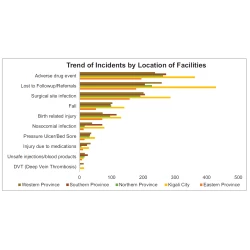
Background or Objectives: Quality and safety of health care service delivery remain a challenge worldwide due to unsafe care, inappropriate practices, adverse events and medication errors that result in harm, disability and death of patients. This study examines the status of quality and safety management of health care service delivery in public hospitals in Rwanda. Methods: The study was a descriptive cross-sectional study. Overall population of interest comprised of 564 hospital managers from 47 hospitals. An online email-based questionnaire was used for data collection. Statistical analysis included bivariate, multivariable, and logistic regression analyses with significance at p <0.05. Data were analyzed using Statistical Package for Social Sciences (IBM Corp. Released 2012. IBM SPSS Statistics for Windows, Version 21.0. Armonk, NY: IBM Corp.). Results: The study sample population was 235 managers (5 persons from each hospital). Of the 235 responses received, 72.3% were from male managers and 27.7% were from female managers. The prevalence of adverse events among public hospitals in Rwanda is 0.007% (p=0.02, 95% CI: 0.017-0.023) with risk of incidents of 0.073%. In all, 98.7% of public hospitals reported incidents, and only 39.3% of them have regularly reported all types of incidents. The most common incidents were adverse drug event (25.3%), loss to follow-up/referrals (25%), and surgical site infection (20%). Rwanda has 0.043 (IQR: 0.032-0.060) doctors per 1,000 population. The country also has 0.25 (IQR: 0.18-0.33) nurses per 1,000 population. The 76.5% of respondents reported that variation of consultation time is between 10-15 minutes (p=0.003, 95% CI: 0.002-0.004) which is associated with 0.12% risk of incidents. The public hospitals have on average 44.25 ± 13.46 SD consultations per clinician per day. More than a half of respondents 54.3% (p=0.033, 95%CI: 0.029- 0.036) reported that 10-20% of treatment given to patients were not needed and are significantly associated with high risk of incidents. The public hospitals score Level 1(documentation) (p=0.016, 95%CI: 0.014-0.019) for quality health care services delivery and, over half score Level 2(implementation). They also score Level 1(documentation) (p: 0.209, 95%CI: 0.201-0.216) for safe health care, and approximately half of them score Level 2(implementation). Conclusion and Implications for Translation: The quality and safety of health care services should be a priority for health care professionals and health care systems. The culture of blame and punishment is a challenge across hospitals. Reassuring adverse events reporting and learning from errors need to be emphasized and prioritized in public hospitals.
Downloads
Similar Articles
- Cameran M Mosley, Emmanuel Ofori, Caylin E Andrews, Elizabeth Armstrong-Mensah, Individual and Community Level Factors Related to HIV Diagnosis, Treatment, and Stigma in Kumasi, Ghana: A Field Report , Vol. 6 No. 1 (2022): The International Journal of Translational Medical Research and Public Health (IJTMRPH)
- Mohamed Rida Tagajdid, Safae Elkochri, Hicham Elannaz, Rachid Abi, Idriss Lahlou Amine, Epidemiological, Clinical and Virological Characteristics of Patients with Hepatitis C in Morocco , Vol. 4 No. 1 (2020): The International Journal of Translational Medical Research and Public Health (IJTMRPH)
- Chinyelu O Mba, Ransom B Jacob, Mercy B Green, Loveday U Zebedee, Hematological Profile of Pregnant Women in Port Harcourt, Nigeria , Vol. 3 No. 1 (2019): The International Journal of Translational Medical Research and Public Health (IJTMRPH)
- Deepa Dongarwar, Brisa Y Garcia, Sitratullah O Maiyegun, Korede K Yusuf, Hamisu M Salihu, COVID-19 Early Vaccination Rates and Gross Domestic Product Per Capita , Vol. 5 No. 1 (2021): The International Journal of Translational Medical Research and Public Health (IJTMRPH)
- Matiur Rahman, Kaoser Bin Siddique, Mohammad Mahbub Ur Rahim, Cancer Registry in Bangladesh: Challenges and Opportunities , Vol. 8 No. Continuous (2024): The International Journal of Translational Medical Research and Public Health (IJTMRPH)
- Elizabeth Afibah Armstrong-Mensah, Ato Kwamena Tetteh, HIV Prevention in sub-Saharan Africa: Where Are Adolescents in the Continuum? , Vol. 5 No. 2 (2021): The International Journal of Translational Medical Research and Public Health (IJTMRPH)
- Deepa Dongarwar, Ebubechi K Adindu, Ruth Mizu, Hamisu M Salihu, Racial/Ethnic Disparities in Preeclampsia, Eclampsia, and HELLP Syndrome Hospitalizations Rates in the United States , Vol. 6 No. 1 (2022): The International Journal of Translational Medical Research and Public Health (IJTMRPH)
- Jacklyn C Fuller, Mary C Ottolini, Motivators and Incentives of Pediatric Medical Educators in an Academic Hospital Setting in the United States , Vol. 2 No. 2 (2018): The International Journal of Translational Medical Research and Public Health (IJTMRPH)
- Marilyn Murrillo, On Utilizing Artificial Intelligence to Impact Healthcare in Low-Income Countries , Vol. 8 No. Continuous (2024): The International Journal of Translational Medical Research and Public Health (IJTMRPH)
- Nsofwa Jubedah Mwansa, Victor Daka, David Mulenga, Ruth L Mfune, Bright Mukanga, Christopher Nyirenda, Seter Siziya, Correlates of Seizure Control Among Patients with Epilepsy at Two Referral Hospitals in Zambia , Vol. 4 No. 2 (2020): The International Journal of Translational Medical Research and Public Health (IJTMRPH)
You may also start an advanced similarity search for this article.
Published
How to Cite
Issue
Section
License
Copyright © 2019 Deogratias Ndagijimana, Connie Mureithi, Nicholas Njau Ngomi. Published by Global Health and Education Projects, Inc., USA.

This is an open-access article distributed under the terms of the Creative Commons Attribution-NonCommercial-ShareAlike 4.0 International License , which permits others to remix, transform, and build upon the work non-commercially, provided the original author is credited and the new creations are licensed under the same terms.



 .
.

