
Polio Eradication in Nigeria and India: A Systematic Review of Challenges and Successes
DOI:
https://doi.org/10.21106/ijtmrph.92Keywords:
- Polio,
- Immunization,
- Nigeria,
- India,
- Pakistan,
- Eradication,
- Systematic Review
Abstract
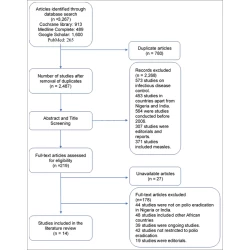
Background: The global eradication of polio is considered an emergency and an unaccomplished task until completely eliminated. Vaccinating children against the polio virus confers immunity on them and breaks the transmission of the polio virus. Afghanistan, Nigeria and Pakistan remain the only three countries in the world that have not eliminated polio. The aims of this paper were to: (1) to identify the factors that impact the failure to eliminate polio from Nigeria and (2) determine the factors that led to the successful elimination of polio from India. Methods: A systematic literature review was carried out to meet the above research objectives. Four electronic databases were searched (Cochrane Library, Medline, PubMed and Google Scholar) and articles that fulfilled the inclusion and exclusion criteria were selected and critically appraised. Results: In all, 98 articles were retrieved. After selection based on our selection criteria, fourteen studies were identified and included in the study. These were 5 systematic reviews: 3 cross-sectional studies, 3 mixed methods studies, 2 case-control studies and one quantitative (survey) study. In all, seven themes were identified from the review of the articles. Four themes were identified from the factors associated with the failure to eliminate polio from Nigeria: (1) Failure of the oral polio vaccine (OPV); (2) Institutional and geographical failures in vaccine programs; (3) Program and campaign management limitations; and (4) Vaccine refusal. Similarly, three themes were identified from the factors that contributed to the elimination of polio from India: (1) Replacement of the trivalent OPV with the monovalent and bivalent OPVs; (2) Implementation of intensive social mobilization strategies; and (3) Effective program micro planning and campaign management. Conclusion and Implications for Translation: Based on the findings from the literature review, we highlight areas where Nigeria can learn from India in its quest to eliminate polio. These factors can form the basis for future theoretical and policy reforms in the fight against polio not only in Nigeria but in countries where it remains endemic. Further research should compare the success of polio eradication in other countries.
Downloads
Similar Articles
- Amina A. Umar, Yusuf D. Jobbi, Hassan Adam Murtala, Aisha Adam Abdullahi, Muktar H. Aliyu, Sani H. Aliyu, Eknath Naik, Ololade D. Adeyemi, Deepa Dongarwar, Hamisu M. Salihu, Socioeconomic and Clinical Determinants of Nutritional Phenotypes among Children with Sickle Cell Disease , Vol. 9 No. Continuous (2025): The International Journal of Translational Medical Research and Public Health (IJTMRPH)
- Sergio Navarro, Kelsey Stewart, Katelyn M Tessier, Aemon Berhane, Susana Prestinary Alvarado, Tavonga Tafirei, Hodan Abdi, Evan J Keil, Todd Tuttle, Jennifer Rickard, Medical Students’ Perceptions of Clinical and Research Training: An International Needs Assessment of 26 Countries , Vol. 7 No. 2 (2023): The International Journal of Translational Medical Research and Public Health (IJTMRPH)
- Anagha Lokhande, Improving Reproductive and Maternal Healthcare Uptake in India: An Evaluation of Project Ujjwal Public-Private Partnership Program , Vol. 7 No. 2 (2023): The International Journal of Translational Medical Research and Public Health (IJTMRPH)
- Ikenna J Nwakamma, Carol S Talla, Stephanie E Kei, Genevieve C Okoro, Godwin Asuquo, Kema A Onu, Adolescent and Young People’s Utilization of HIV/Sexual and Reproductive Health Services: Comparing Health Facilities and Mobile Community Outreach Centers , Vol. 3 No. 2 (2019): The International Journal of Translational Medical Research and Public Health (IJTMRPH)
- Christopher S Oyamienlen, Charles A Adisa, Ikechukwu N. S Dozie, Evangeline T Oparaocha, Angelica A Anele, Kingsley C Anochiwa, Body Mass Index and Breast Cancer Risks Among Igbo Women in Imo and Abia States, Nigeria: A Case Control Study , Vol. 3 No. 1 (2019): The International Journal of Translational Medical Research and Public Health (IJTMRPH)
- George Ikpe, Juliet Enukeme, Chukwuemeka Amuta, Ikenna Nwakanma, Orieji Agomoh, Okwudili Chukwudinma, Chioma Ukanwa, Peter Nwaokenneya, Advanced HIV Disease among Persons Newly Diagnosed with HIV: A Hospital-Based Study in Abia State, Nigeria , Vol. 9 No. Continuous (2025): The International Journal of Translational Medical Research and Public Health (IJTMRPH)
- Iddi Matovu, Miph Musoke, HIV Infection Among Adolescent Girls and Young Women in Sub-Saharan Africa: Philosophical Perspectives of Sociostructural Risk Factors , Vol. 8 No. Continuous (2024): The International Journal of Translational Medical Research and Public Health (IJTMRPH)
- Chinyelu O Mba, Ransom B Jacob, Mercy B Green, Loveday U Zebedee, Hematological Profile of Pregnant Women in Port Harcourt, Nigeria , Vol. 3 No. 1 (2019): The International Journal of Translational Medical Research and Public Health (IJTMRPH)
- Sara F Khan, Deepa Dongarwar, Hamisu M Salihu, Intimate Partner Violence Among Adolescent Latina Mothers and Their Reproductive Outcomes: A Systematic Review , Vol. 6 No. 2 (2022): The International Journal of Translational Medical Research and Public Health (IJTMRPH)
- Victoria Funmilayo Hanson, Olayinka A Onasoga, Christianah Olayemi Babalola, Working Conditions and Productivity among Nurses in Selected Hospitals in Southwest Nigeria , Vol. 1 No. 2 (2017): The International Journal of Translational Medical Research and Public Health (IJTMRPH)
<< < 1 2 3 4 5 6 7 8 9 10 > >>
You may also start an advanced similarity search for this article.
Published
How to Cite
Issue
Section
License
Copyright © 2019 Ahmed A Bulama, Jane Goodman-Brown. Published by Global Health and Education Projects, Inc., USA.

This is an open-access article distributed under the terms of the Creative Commons Attribution-NonCommercial-ShareAlike 4.0 International License , which permits others to remix, transform, and build upon the work non-commercially, provided the original author is credited and the new creations are licensed under the same terms.



 .
.

