
Willingness to Become Deceased Organ Donors among Post‑graduate Students in Selected Colleges in Kathmandu Valley, Nepal
DOI:
https://doi.org/10.21106/ijtmrph.77Keywords:
- Deceased Organ Donation,
- Willingness,
- Kathmandu,
- Nepal,
- Organ Transplantation,
- Living Donor,
- Deceased Donor
Abstract
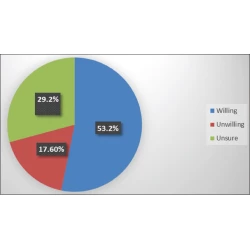
Introduction: Globally, there is a discrepancy between demand and availability of organs for transplantation. Transplantation is done from a living donor as well as a brain-dead/deceased donor. However, the World Health Organization (WHO) encourages deceased donor transplantation, since there is no risk to the donor. Although, the Transplant Act of Nepal 2016 opened the doors for deceased donor organ transplantation, the rate of transplantation from deceased donors is very low. Thus, this study assesses factors associated with willingness for deceased organ donation among post-graduate students of law, medicine, and mass communication streams. Methods: A total of 9 colleges, 3 from each specialty were selected via lottery method. The total sample size calculated was 440. A self-administered questionnaire was used to collect the data. 170, 140 and 130 forms were distributed in law, medicine and mass communication respectively via convenient sampling. Multivariate analysis among the variables that had p-value <0.05 in bivariate analysis was carried out to find out the strongest predictors of willingness to be a deceased organ donor. Results: In all, 53.2% were willing to become deceased organ donors. Family permission having someone in family with chronic disease, having attended any conference or general talk on organ donation, knowing a live organ donor, and knowing that body will not be left disfigured after organ extraction were found to be the strongest predictors for willingness to be deceased organ donor. Lack of awareness was reported as the main barrier. Conclusion: There is a need for extensive awareness programs and new strategies to motivate individuals and family members for organ donation.
Downloads
Similar Articles
- Musa Baba Maiyaki, Garba Dahiru, Amina Abdullahi, Tijjani Hussaini, Sabitu Shuaibu, Mohammed Auwal Ibrahim, Auwal Adamu, Nura Mohammed, Mahmoud Habib Maje, Hamisu M Salihu, Profiles and Characteristics of Patients with Mild to Moderate COVID -19 Disease Phenotypes in a Teaching Hospital in Kano, Northern Nigeria , Vol. 6 No. 1 (2022): The International Journal of Translational Medical Research and Public Health (IJTMRPH)
- Judith Eberhardt, Jonathan Ling, A Qualitative Exploration of Perceptions of the COVID-19 Vaccine in the United Kingdom During the Later Stages of the Vaccine Rollout , Vol. 6 No. 1 (2022): The International Journal of Translational Medical Research and Public Health (IJTMRPH)
- Hyunjung Lee, Gopal K Singh, Marked Disparities in Cardiovascular Disease Mortality by Levels of Happiness and Life Satisfaction in the United States , Vol. 4 No. 2 (2020): The International Journal of Translational Medical Research and Public Health (IJTMRPH)
- Soupriye B Zibima, Kenneth B Wasini, Juliet I Oniso, Disparities in Urban and Rural Dwelling Adolescents’ Educational Needs for Obesity Prevention in Nigeria , Vol. 4 No. 2 (2020): The International Journal of Translational Medical Research and Public Health (IJTMRPH)
- Musa M Dogara, Saadatu Ahmad, Babalola J Balogun, Salwa S Dawaki, Muzammil B Mustapha, Aminu U Abdurrahman, Lawal Bala, Abubakar Zakari, David U Livingstone, Schistosomiasis and Associated Risk Factors Among School-Aged Children in Northern Nigeria , Vol. 4 No. 2 (2020): The International Journal of Translational Medical Research and Public Health (IJTMRPH)
- Nasir Ilyas, Romuladus E Azuine, Alina Tamiz, COVID-19 Pandemic in Pakistan , Vol. 4 No. 1 (2020): The International Journal of Translational Medical Research and Public Health (IJTMRPH)
- John A Markson, Early Infant Diagnosis of HIV in Primary Health Care Centers , Vol. 5 No. 1 (2021): The International Journal of Translational Medical Research and Public Health (IJTMRPH)
- Maureen Atieno Adoyo, Yeri M Kombe, Gestational Diabetes Mellitus and Associated Health Risk Outcomes in Mothers and Neonates , Vol. 4 No. 1 (2020): The International Journal of Translational Medical Research and Public Health (IJTMRPH)
- Bright Opoku Ahinkorah, Abdul-Aziz Seidu, Eugene Budu, Ebenezer Kwesi Armah-Ansah, Ebenezer Agbaglo, Collins Adu, Edward Kwabena Ameyaw, Sanni Yaya, Factors Associated with Utilization of Postnatal Care Services in Mali, West Africa Bright Opoku Ahin , Vol. 5 No. 1 (2021): The International Journal of Translational Medical Research and Public Health (IJTMRPH)
- Fatima Usman, Zubairu Iliyasu, Hamisu M Salihu, Muktar H Aliyu, COVID-19 Pandemic and Medical Education in Nigeria , Vol. 5 No. 2 (2021): The International Journal of Translational Medical Research and Public Health (IJTMRPH)
You may also start an advanced similarity search for this article.
Published
How to Cite
Issue
Section
License
Copyright © 2019 Pragya Paneru, Samyog Uprety, Shyam S Budhathoki, Birendra K Yadav, Suman L Bhandari. Published by Global Health and Education Projects, Inc., USA.

This is an open-access article distributed under the terms of the Creative Commons Attribution-NonCommercial-ShareAlike 4.0 International License , which permits others to remix, transform, and build upon the work non-commercially, provided the original author is credited and the new creations are licensed under the same terms.



 .
.

