
Factors Associated with Alcohol Consumption Among Students in High-Cost Schools in Lusaka, Zambia
DOI:
https://doi.org/10.21106/ijtmrph.69Keywords:
- Adolescent Alcohol Consumption,
- Attitude Towards Alcohol,
- Parental Monitoring,
- Parental Alcohol Use,
- Pocket Money
Abstract
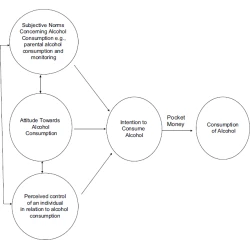
Introduction: The prevalence of alcohol consumption among adolescents is very high in Zambia, in spite of the knowledge on the negative effects of alcohol consumption on adolescents. The objective of this study was to determine factors associated with alcohol consumption among secondary school students in high-cost public schools. Methods: A cross-sectional study of 357 students in Grades 8 and 11 was conducted. Data were collected using structured questionnaires. The associations and correlations between explanatory variables and the outcome of interest was established using Chi-square or the Fisher’s exact test. Magnitudes of association were estimated using Odds ratio. Results: The prevalence of alcohol consumption among the students was 43.7%. Factors predictive of students’ alcohol use were attitude towards alcohol consumption (Adjusted Odds Ratio (AOR) =3.15, 95% Confidence Interval (CI) [1.04,9.56]), parental monitoring (AOR=0.69, 95% C.I. [0.69, 0.94]), parental alcohol use (AOR= 1.76, 95% C.I. [1.39,2.23]) and pocket money availability (AOR= 1.52, 95% C.I. [1.03,2.26]). The prevalence of alcohol consumption was high. Students with positive attitudes towards alcohol consumption were found to be 3.15 times more likely to drink alcohol compared to students with negative attitudes. Students who are highly monitored by their parents were found to be 31% less likely to drink alcohol compared to those rarely monitored by their parents. Students whose parents drink alcohol were found to be 76% more likely to drink alcohol compared to those whose parents do not drink alcohol. Students with a high amount of pocket money were found to be 52% more likely to drink alcohol compared to those without pocket money. Conclusion and Implication for Translation: Results indicate a high prevalence of alcohol consumption among secondary school students of high-cost schools. Potential interventions should focus on inclining the students’ attitudes against alcohol consumption, encouraging increased parental monitoring, and teaching students how to use their pocket money more appropriately.
Downloads
Most read articles by the same author(s)
- Nsofwa Jubedah Mwansa, Victor Daka, David Mulenga, Ruth L Mfune, Bright Mukanga, Christopher Nyirenda, Seter Siziya, Correlates of Seizure Control Among Patients with Epilepsy at Two Referral Hospitals in Zambia , International Journal of Translational Medical Research and Public Health: Vol. 4 No. 2 (2020): The International Journal of Translational Medical Research and Public Health (IJTMRPH)
Similar Articles
- Esther Ayaaba, Yi Liu, Yan Li, Lei Han, Quansah Dan Yedu, Ni Chunhu, Measures to Control the Prevalence of Pneumoconiosis in Coal Mining: A Review of the Literature , Vol. 1 No. 1 (2017): The International Journal of Translational Medical Research and Public Health (IJTMRPH)
- Romuladus E Azuine, Gopal K Singh, Shanita D Williams, Evangeline T Oparaocha, Shiv C Mathur, Translating Public and Population Health Research into Policy and Actions: The International Journal of Translational Medical Research and Public Health (IJTMRPH) , Vol. 1 No. 1 (2017): The International Journal of Translational Medical Research and Public Health (IJTMRPH)
- Dania Matta, Patti Herring, W. Lawrence Beeson, Seth Wiafe, The Role of Perceived Susceptibility, Perceived Severity, Perceived Barriers and Benefits in COVID-19 Vaccine Hesitancy and Uptake Among Outpatient Surgery Nurses in the United States: A Qualitative Study , Vol. 7 No. 1 (2023): The International Journal of Translational Medical Research and Public Health (IJTMRPH)
- Laila Al Afnan, Hunger in America: Examining the Far–Reaching Effects of Food Insecurity in the United States of America , Vol. 8 No. Continuous (2024): The International Journal of Translational Medical Research and Public Health (IJTMRPH)
- semvua kilonzo, Hyasinta Jaka, Sylvanus Mapunda, Knowledge and Risk Assessment of Hepatitis B Infection among Barbers and Beauty Salon Workers in Mwanza, Tanzania , Vol. 8 No. Continuous (2024): The International Journal of Translational Medical Research and Public Health (IJTMRPH)
- Oluwasola Stephen Ayosanmi, Lorette Oden, Titilope Ayosanmi, Babatunde Alli, Mei Wen, Jamie Johnson, The Role of Health Belief Model in HIV Screening Decision among International Students in the United States: A Pilot Study , Vol. 4 No. 1 (2020): The International Journal of Translational Medical Research and Public Health (IJTMRPH)
- Mahendra Arnold, Sepali Wickramatilake, Palitha Karunapema, Dinusha Fernando, Roshan Sampath, Buddhika Mahesh, Sujeewa Panditharathna, Referral Outcomes of Identified Health Problems and Difficulties Related to School Medical Inspections in Government Schools in an Education Zone in Sri Lanka , Vol. 4 No. 1 (2020): The International Journal of Translational Medical Research and Public Health (IJTMRPH)
- Albert Apotele Nyaaba, Augustine Tanle, Louis Kobina Dadzie, Matthew Ayamga, Determinants of Under-Five Mortality in Ghana: Evidence from the Ghana Demographic and Health Survey , Vol. 4 No. 2 (2020): The International Journal of Translational Medical Research and Public Health (IJTMRPH)
- Elizabeth Armstrong Mensah, Maria Adjini, Bria Pringle-Weston, Akwasi Akosah, Rachael Addo, Late Dementia Diagnosis Among Elderly Minority Populations in the United States: Causes, Effects, and Addressing Inequities , Vol. 8 No. Continuous (2024): The International Journal of Translational Medical Research and Public Health (IJTMRPH)
- Laila Al Afnan, Enhancing Hepatitis B Awareness and Risk Management in Barbershops and Salons: A Call for Tailored Interventions , Vol. 8 No. Continuous (2024): The International Journal of Translational Medical Research and Public Health (IJTMRPH)
You may also start an advanced similarity search for this article.
Published
How to Cite
Issue
Section
License
Copyright © 2019 Chongo Clays Siwale, Seter Siziya. Published by Global Health and Education Projects, Inc., USA.

This is an open-access article distributed under the terms of the Creative Commons Attribution-NonCommercial-ShareAlike 4.0 International License , which permits others to remix, transform, and build upon the work non-commercially, provided the original author is credited and the new creations are licensed under the same terms.



 .
.

