Contact Lens Use and Prescribing Trends in Suburban Selangor, Malaysia: A Retrospective Study

*Corresponding author: Noor Halilah Buari, Centre for Optometry Studies, Faculty of Health Science, Universiti Teknologi MARA Selangor, Puncak Alam Campus, 42300 Bandar Puncak Alam, Selangor, Malaysia noorhalilah@uitm.edu.my
-
Received: ,
Accepted: ,
ABSTRACT
Background and Objective
Contact lens use is an increasingly common vision care practice worldwide, offering convenience and aesthetic appeal. However, inappropriate prescribing and unsafe use of contact lenses are associated with ocular complications, making this an important public health issue. Understanding prescribing patterns within specific populations can provide valuable insights to promote safe lens use and prevent avoidable eye health problems. Therefore, this study aims to investigate the prescription trends of disposable soft contact lenses in selected suburban areas of Selangor, Malaysia.
Methods
A retrospective review of 396 disposable contact lens prescriptions from 10 optometry clinics was conducted from January 2019 to December 2020. Data on demographic characteristics and contact lens criteria (modality, design, material, and water content) were extracted.
Results
Descriptive statistics were used to summarize the prescription patterns. The mean age of contact lens wearers was 25.3 ± 9.7 years, with a female predominance (87%). Monthly disposable lenses were most frequently prescribed (79%), followed by 1–2-week (10%) and 3–6-month lenses (8%). Daily disposable lenses accounted for only 3%. Cosmetic tinted lenses dominated design preferences (50%), followed by spherical lenses (40%). Hydrogel lenses were prescribed more often (64%) than silicone hydrogel (36%). Nearly equal distribution was observed for low- and medium-water content (46% and 45%, respectively).
Conclusion and Implications for Translation
Suburban prescribing trends are strongly influenced by affordability and aesthetics, with young women representing the largest consumer group. However, the low uptake of daily disposables and the widespread use of cosmetic lenses raise concerns about ocular safety and potential public health risks. These findings may suggest potential value in community-based education on safe lens practices, regulatory oversight of cosmetic lens sales, and strategies to improve equitable access to safer contact lens options.
Keywords
Contact Lenses
Disposable Contact Lenses
Prescription
Suburban
Optometry
INTRODUCTION
Background of the Study
Disposable contact lenses are medical devices intended for short-term use, often preferred for convenience, hygiene, and ease of maintenance. Technological innovation, increased awareness of ocular health, and lifestyle compatibility drive their growing global popularity. Despite global shifts towards daily disposables due to health and convenience benefits, lens prescribing trends vary widely depending on demographic and socioeconomic contexts. Studies indicate that disposable lenses now account for a significant proportion of all soft contact lens prescriptions, with adoption rates steadily increasing since the mid-1990s.[1,2]
Disposable contact lenses, particularly daily disposables, have gained widespread popularity, accounting for 27.1% of all soft lens fits in the U.S. by 2014, up from lower percentages in previous years.[3] These lenses are often preferred in urban populations, where higher income levels, greater health literacy, and better access to optometric services support uptake of premium and safer lens options.[1] These trends can also be seen in countries like Japan, Norway, and the UK, especially among part-time users.[4] Conversely, rural populations may experience limited access to eye care services and lower contact lens penetration overall.[5] Suburban populations occupy an intermediate position within this urban–rural continuum and are undergoing several socioeconomic transitions. However, evidence on contact lens prescribing patterns in suburban communities remains limited, despite rapidly growing populations and increasing demand for vision correction services.
The demographics of contact lens users play a crucial role in shaping prescribing patterns. For instance, younger populations, particularly those with active lifestyles, tend to prioritize convenience and aesthetic appeal when choosing contact lenses.[1,2] Female users constitute a substantial proportion of contact lens wearers worldwide and often report stronger preferences for cosmetic enhancement and non-spectacle vision correction.[4,6] The existing urban-based studies suggest that aesthetic preferences and the widespread availability of cosmetic contact lenses may influence consumer demand, particularly among younger female users; however, whether similar patterns apply to suburban populations remains uncertain due to limited empirical evidence.
Material selection further influences prescription trends, with silicone hydrogel lenses becoming increasingly popular due to their superior oxygen transmissibility and comfort.[1,7]Water content is also physiologically relevant, as it affects lens dehydration, comfort, and ocular surface health, particularly during prolonged wear. However, cost remains a limiting factor as daily disposable lenses and premium silicone hydrogel materials are often priced higher, making them less accessible to financially constrained wearers.[8] These disposable contact lenses have made contact lenses more comfortable and safe, driving the adoption of those particular lenses over conventional daily-wear lenses.[7] Affordability may be an important consideration influencing contact lens selection; however, the extent to which cost-relatedfactors affect prescribing decisions and reliance on reusable or cosmetic lenses remains unclear. Understanding these potential trade-offs is essential to inform public health strategies that promote safer contact lens use without compromising accessibility.
Objectives of the Study
While global literature has extensively documented contact lens prescribing trends in urban and high-income settings, evidence from suburban populations, particularly in Malaysia, remains scarce. Suburban communities represent a distinct, transitional group between urban and rural environments, characterized by rapid urbanization, youthful demographics, and evolving consumer health behaviors. These characteristics may influence contact lens prescribing patterns differently from those reported in urban-centric studies. From a public health perspective, understanding prescribing trends in suburban settings is important, as inappropriate contact lens use is associated with preventable ocular complications. Therefore, this study aims to document prescription trends of disposable contact lenses in selected suburban areas of Selangor, Malaysia. Examining contact lens prescribing in this context provides novel, locally relevant evidence that complements existing urban-centric and international data.
METHODS
Study Design and Sampling
This study employed a retrospective record review to analyze prescription trends of disposable soft contact lenses in the suburban area of Selangor. Data were collected from January 2019 to December 2020 across 10 purposively selected optometry clinics within a 20-km radius of Bandar Puncak Alam. Only optometry clinics with available prescription records for disposable soft contact lenses during the study period were included. Non-disposable and specialty lens types (e.g., rigid gas permeable) were excluded.
According to the Department of Statistics Malaysia, an urban area is a gazetted area with a high-density population, developed infrastructure, and access to a wide range of services and economic opportunities.[9] Conversely, suburban areas are residential zones on the periphery or outskirts of the urban center. The suburban area is characterized by moderate population density, a mix of residential and small-scale commercial development, and often acts as a transition zone between urban and rural areas. This study selected Bandar Puncak Alam, Mukim Jeram of Kuala Selangor, as a suburban area.
Bandar Puncak Alam is a fast-expanding suburban area, located 40 km northwest of Kuala Lumpur in Selangor, Malaysia, with an estimated population exceeding 200,000 residents, according to the Department of Statistics Malaysia. Now a mixed-development hub with expanding commercial, educational, and healthcare institutions, it was initially a residential area. Despite its ongoing urbanization, Puncak Alam retained suburban traits, including moderate population density and a mix of urban and rural areas. Optometry and ophthalmology clinics are still scarcer than in major cities, even though basic amenities are developing. Due to this reason, this study is essential to investigate how it influences contact lens prescription patterns.
Data Collection
Ethical approval was obtained before the commencement of data collection via the Universiti Teknologi MARA Research Ethics Committee (REC/01/2019(UG/MR/1)). Permission letters were distributed to participating optometry practices, and only those who granted formal consent were included in the study.
Patients’ records were reviewed and categorized based on demographic characteristics, including age and gender. The disposable soft contact lens records were extracted based on contact lens criteria, including lens modalities, designs, materials, and water content.
Lens modalities were categorized by daily disposables, 1–2-week disposables, monthly disposables, and 3–6-month disposables. To determine the proportion of lens designs, the data were grouped into spherical, toric, multifocal, or other categories, such as cosmetic tints. The records were categorized as hydrogel or silicone hydrogel to determine the proportion of contact lenses by material. Lastly, the data were extracted according to contact lens water content and categorized as high water (>60% content), mid-water (40%–60% content), and low water (<40% content).
Statistical Analysis
All extracted data were recorded in structured tables in Microsoft Excel (version 16, 2023) and subsequently transferred to IBM Statistical Package for the Social Sciences (SPSS) Statistics for Windows (26.0, IBM Corp.) for further analysis. Descriptive statistics were used to summarize prescription patterns across lens modalities, materials, and patient demographics using frequencies and percentages. This descriptive-analytical approach was selected to characterize prescribing trends and to enable replication in other suburban or comparable population settings. Inferential analyses were not performed because the study was descriptive and based on retrospective records without outcome measures.
RESULTS
A total of 396 disposable contact lens prescriptions, each corresponding to a unique individual patient, were reviewed from ten optometry practices within a 20 km radius of Bandar Puncak Alam, covering the period from January 2020 to December 2020. The average age was 25.3 ± 9.7 years, ranging from 15 to 60 years. The analysis of 396 data points revealed a substantial gender disparity in the use of disposable soft contact lenses. Females constituted 87% (n = 345) of the prescribed contact lens users, whereas males accounted for 13% (n = 51).
The distribution of prescribed disposable contact lenses by replacement modality showed a strong preference for monthly disposable lenses, which accounted for 79% (n = 314) of all prescriptions. Then, 1–2-week disposable lenses accounted for 10% (n = 39) of prescriptions, and 3–6-month disposable lenses accounted for 8% (n = 30) of prescriptions. Daily disposable lenses accounted for only 3% (n = 13) of prescriptions, the lowest among all modalities. The proportion of lens modalities for disposable contact lenses is illustrated in Figure 1.
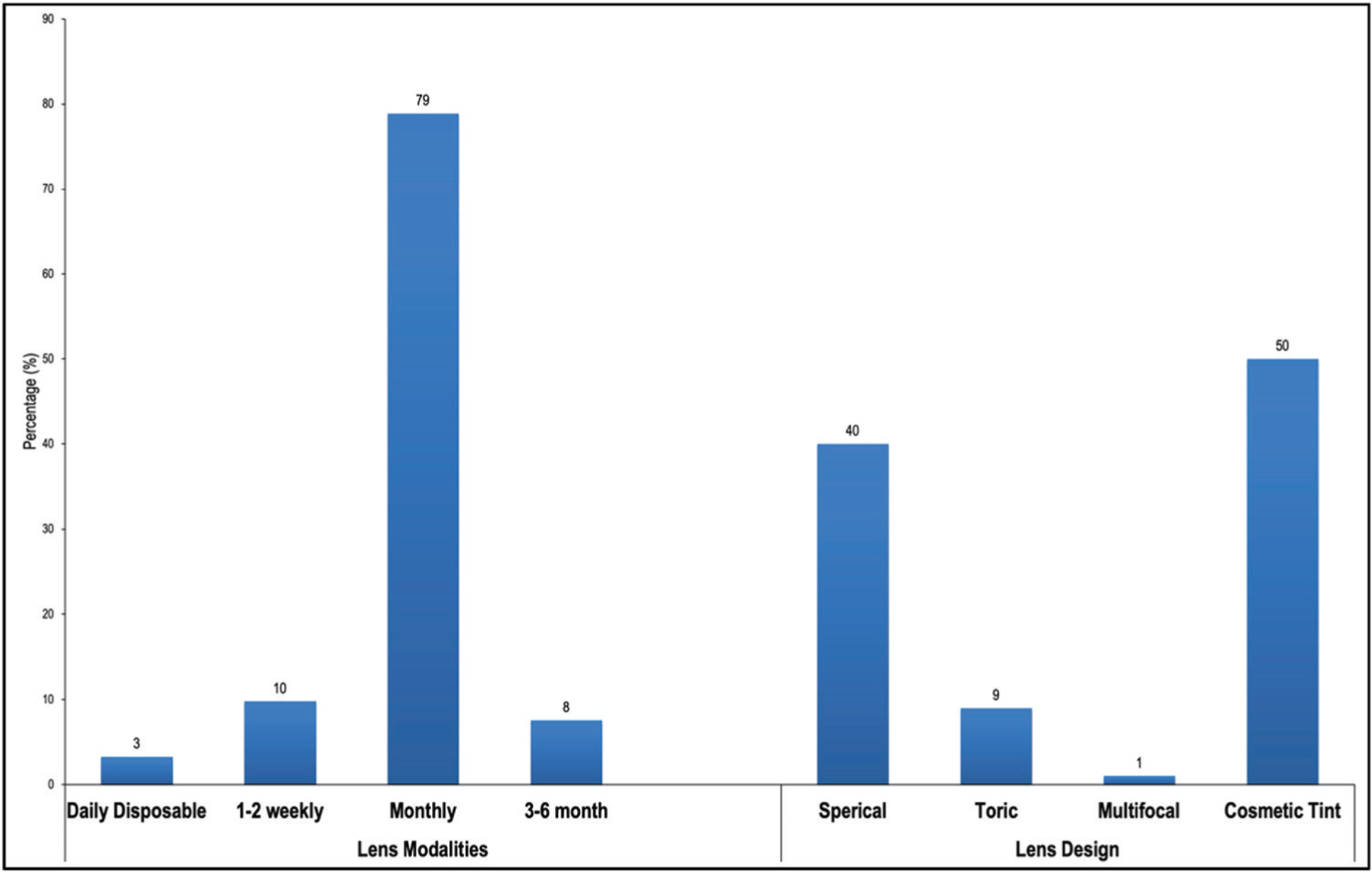
- Distribution of prescribed disposable contact lenses for lens modalities and lens designs.
The prescribed contact lens designs were classified into four categories: spherical, toric, multifocal, and cosmetically tinted lenses. As exhibited in Figure 1, spherical lenses accounted for 40% of the prescriptions, making them the most commonly prescribed for refractive correction. Toric and multifocal lenses accounted for only 9% and 1% of prescriptions, respectively. However, tinted cosmetic lenses accounted for 50% of all prescriptions, making them the most frequently prescribed contact lens type.
A review of prescribed lens materials revealed that 64% (278) of the contact lenses were hydrogel, whereas 36% (118) were silicone hydrogel. This indicated a greater preference for hydrogel lenses among practitioners and patients [Table 1].
| Criteria | Frequencies (n) | Percentage (%) |
|---|---|---|
| Lens material | ||
| Hydrogel | 278 | 64 |
| Silicone hydrogel | 118 | 36 |
| Water content | ||
| Low (<40%) | 183 | 46 |
| Medium (40–60%) | 180 | 45 |
| High (>60%) | 33 | 8 |
Table 1 also presents the prescribed distribution of disposable contact lenses by water content. The findings showed a nearly equal preference for low-water-content (<40%) and medium-water-content (40–60%) lenses, at 46% (n = 183) and 45% (n = 180), respectively. Conversely, high-water content lenses (>60%) accounted for only 8% (n = 33) of prescriptions.
DISCUSSION
The following discussion interprets these prescribing patterns in relation to demographic characteristics and public health implications relevant to suburban populations. The findings indicated a significant gender disparity in disposable soft contact lens prescriptions in suburban areas, with more female wearers than males. This trend aligned with previous studies indicating that about two-thirds of daily disposable lens wearers were women, reflecting a worldwide gender preference.[1,2,6] Another study about the pattern of contact lens prescription in Singapore also found that contact lens wearers tended to be young females.[10] Our study also echoed previous studies in Malaysia, in which most contact lens wearers were female.[11] The present study demonstrated a similar gender distribution to that reported in previous urban-based studies, despite differences in the study setting. This is probably because females are more likely to adopt contact lenses due to aesthetic preferences, greater contact lens awareness, and a greater inclination toward non-spectacle vision correction.[2,6,11]
This study found that the mean age of patients prescribed disposable soft contact lenses (25.3 years) was lower than that reported in the United States and Australia (33 years)[3,4] and the United Kingdom (35 years).[8] However, it was comparable to several reports from the Asian regions (27.8 years).[12,13] This study’s lower average age of contact lens users indicated regional disparities in cultural, economic, and lifestyle influences.[4] In Western societies, older individuals may utilize contact lenses due to elevated income and occupational demands, whereas in suburban areas, as in our study, younger users prioritize cosmetic appeal and visual corrective management.[14]
The predominance of monthly lenses and hydrogel materials may reflect a balance between affordability and perceived convenience in suburban practice, where cost considerations may influence both patient demand and practitioner recommendations. Monthly lenses offer a cost-effective compromise between hygiene and convenience, whereas hydrogel lenses remain popular for their lower cost and initial comfort despite their lower oxygen permeability compared with silicone hydrogel lenses.[4,14] The low uptake of daily disposables observed in this study may suggest a cost barrier to safer lens options, especially among younger adults who dominate the market.[8,15] While clinical outcomes were not assessed, this prescribing pattern raises public health concerns, as reliance on reusable lenses may limit access to newer technologies that offer improved ocular safety.
Previous studies have shown that lower oxygen transmissibility in hydrogel lenses may contribute to corneal hypoxia and related complications, particularly during prolonged or extended wear. Conversely, daily disposable lenses, particularly those made from silicone hydrogel materials, provide higher oxygen permeability and single-use hygiene advantages, which help reduce deposit buildup and lower the risk of contact lens-related infection and hypoxia-related changes.[16] Furthermore, inadequate hygiene practices, overnight wear, and reuse of contact lenses have been consistently associated with complications such as microbial keratitis, corneal inflammation, and corneal ulcers.[17,18]Although these outcomes were not assessed in the present study, the observed prescribing patterns underscore the importance of safe prescribing, patient education, and hygiene practices, especially among users of reusable and cosmetic contact lenses.
The high uptake of cosmetic contact lenses in this study aligns with previous reports among younger female wearers, where aesthetic motivations often influence contact lens choice.[19,20] Cosmetic lenses are widely used for fashion purposes, and their accessibility in the market likely drives demand. This finding suggests potential value in targeted eye health education for cosmetic lens users, with emphasis on proper lens hygiene, regular follow-up, and awareness of infection risks. Policies such as stricter regulation of cosmetic lens sales and the requirement of qualified practitioners may help reduce misuse. The concurrent under-prescription of toric and multifocal lenses may be due to limited awareness of available contact lenses and their costs. It also highlights disparities in access to specialized vision correction options. Global prescribing trends indicate that toric lens fitting correlates positively with a country’s GDP, with lower prescribing rates observed in less affluent areas.[21,22] Public knowledge and practitioner training on these lenses’ availability and benefits could meet unmet refractive needs and support better visual outcomes.
The near-equal distribution of low-water-content lenses (46%) and medium-water-content lenses (45%), with minimal use of high-water-content lenses (8%), reflects practitioner preferences and patient comfort priorities. Hydrogel lenses, which dominate suburban prescriptions, were typically associated with low to medium water content and offer a balance between moisture retention and comfort. Notably, low-water content lenses are particularly beneficial for patients with dry eyes or those who work in air-conditioned environments, as they retain hydration more effectively and minimize dehydration-related discomfort.[23,24] High-water-content lenses, though comfortable, dehydrate fast under such conditions, making them unsuitable for long-term usage. These populations’ widespread use of low- and medium-water-content lenses helps alleviate dry eye symptoms in high-risk situations. Education on dry eye management and professional lens selection can reduce ocular discomfort and increase long-term contact lens satisfaction.
Limitations and Recommendations
While most contact lens prescribing studies are urban-based or international, this study provides new insights by examining prescribing trends in a suburban area of Selangor, Malaysia. However, the sample was limited to suburban Selangor and 10 optometry clinics, which may not be representative of other regions or rural and urban populations, thereby limiting the generalizability of the findings. Furthermore, reliance on clinic records meant that information on compliance, actual usage behavior, patient perspectives, satisfaction, and health literacy was not captured, which are important determinants of safe and effective contact lens use. Furthermore, as a descriptive, record-based study, the findings should be interpreted cautiously, as causal relationships between demographic factors and prescribing behavior cannot be established.
From a public health perspective, these findings support the need for targeted community-based education to improve knowledge and awareness of proper contact lens usage and hygiene, particularly among cosmetic lens users and younger adults. Strengthened regulatory oversight of cosmetic contact lens distribution is also warranted to ensure lenses are prescribed and dispensed by qualified eye care professionals. Furthermore, strategies to improve equitable access to safer options, such as daily disposable lenses, should be considered through cost-reduction measures, policy incentives, or practitioner-led counseling on long-term safety and cost-benefit.
Future research should expand to include longitudinal prescribing trends, patient-reported outcomes, and the economic determinants of lens selection across diverse populations. Such evidence will be essential for informing public health strategies aimed at reducing preventable complications and supporting safe, equitable contact lens use in Malaysia and beyond.
CONCLUSION AND IMPLICATIONS FOR TRANSLATION
This study highlights prescribing patterns for disposable soft contact lenses in suburban Selangor, where female and younger users dominate the market and show a clear preference for cosmetic and cost-effective monthly lenses. These choices may be influenced by affordability, lifestyle, and aesthetic factors. However, such drivers should not overshadow the importance of safe lens practices. These findings may inform public health planning and future research; however, further studies assessing clinical outcomes are required before firm policy recommendations can be drawn. Nonetheless, the observed prescribing patterns suggest potential value in targeted contact lens education, tighter regulation of cosmetic lens distribution through collaboration between optometry associations and the Ministry of Health, and improved access to safer lens options. Translating these findings into practice will help reduce preventable complications, support safer prescribing behaviors, and guide future community-based interventions in eye health.
Acknowledgments
The authors would like to thank all participating optometry practices for their cooperation and support.
COMPLIANCE WITH ETHICAL STANDARDS
Conflicts of Interest: The authors declare no competing interests. Financial Disclosure: Nothing to declare. Funding/Support: No funding was available for this study. Ethics Approval: Ethical approval for this study was obtained from the Research Ethics Committee, reference number REC/01/2019(UG/MR/1), dated 4 February 2019. Declaration of Patient Consent: The authors confirm that appropriate approval was obtained from the participating practices before reviewing clinical records. Only clinical records related to contact lens prescriptions were accessed. No personal data was extracted, and all patient information was kept strictly confidential to protect anonymity. Use of Artificial Intelligence (AI)—Assisted Technology for Manuscript Preparation: The authors confirm that there was no use of Artificial Intelligence (AI)—Assisted Technology for assisting in the writing or editing of the manuscript, and no images were manipulated using the AI. Disclaimer: None
Key Messages
1. Young female wearers dominate the contact lens market, with a clear preference for cost-effective monthly and cosmetic lenses, indicating how affordability, lifestyle, and aesthetic appeal influence prescribing patterns in suburban communities of Selangor. 2. The low uptake of daily disposables despite their superior safety profile and heavy reliance on cosmetic and hydrogel lenses may increase risks of preventable complications if safe use is not reinforced, highlighting an ongoing public health concern. 3. The findings call for community-based education campaigns and improved access to safer, affordable alternatives to reduce eye health risks and support equitable lens use.
REFERENCES
- International Contact Lens Prescribing Survey Consortium. An international survey of daily disposable contact lens prescribing. Clin Exp Optometry. 2013;96:58-64.
- [Google Scholar]
- Trends in US contact lens prescribing 2002 to 2014. Optometry Vision Sci. 2015;92:758-67.
- [Google Scholar]
- Demographics of international contact lens prescribing. Contact Lens Anterior Eye. 2010;33:27-9.
- [Google Scholar]
- . Profile of contact lens prescribing in GCC countries. Contact Lens Anterior Eye. 2024;47:102128.
- [Google Scholar]
- International trends in prescribing silicone hydrogel contact lenses for daily wear (2000–2023): an update. Contact Lens Anterior Eye. 2024;47:102310.
- [Google Scholar]
- Quarter of a century of contact lens prescribing trends in the United Kingdom (1996–2020). Contact Lens Anterior Eye. 2022;45:101446.
- [Google Scholar]
- Economic Census 2023 (Banci Ekonomi 2023). Putrajaya: DOSM; 2023 [cited 2025 Apr 16]. Available from: http://economiccensus.dosm.gov.my/ec2/index.php/en/
- [Google Scholar]
- The prevalence and pattern of contact lens use in a Singapore community. CLAO J. 2000;26:21-5.
- [Google Scholar]
- Knowledge and practice of contact lens wear and care among medical students of University of Malaya. Med J Malaysia. 2008;63:207-10.
- [Google Scholar]
- Contact lens prescribing pattern in India—2011. Contact Lens Anterior Eye. 2013;36:182-5.
- [Google Scholar]
- Daily disposable contact lenses versus spectacles in teenagers. Optometry Vision Sci. 2015;92:44-52.
- [Google Scholar]
- A ‘cost‐per‐wear’ model based on contact lens replacement frequency. Clin Exp Optometry. 2010;93:253-60.
- [Google Scholar]
- Influence of socio-demographic characteristics on eye care expenditure: data from the medical expenditure panel survey 2007. Ophthal Epidemiol. 2015;22:28-33.
- [Google Scholar]
- Silicone hydrogel versus hydrogel soft contact lenses for differences in patient‐reported eye comfort and safety. Cochrane Database Syst Rev. 2021;2021:CD014791.
- [Google Scholar]
- Contact lens–associated keratitis—an often underestimated risk. Dtsch Arztebl Int. 2022;119: 669-74.
- [Google Scholar]
- A review of contact lens-related risk factors and complications. Cureus. 2022;14:e30118.
- [Google Scholar]
- Demographic profiles of contact lens wearers and their association with lens wear characteristics in Trinidad and Tobago: a retrospective study. PLoS One. 2022;17:e0264659.
- [Google Scholar]
- Patterns of fitting cosmetically tinted contact lenses. Contact Lens Anterior Eye. 2009;32:207–8.
- [Google Scholar]
- International trends in prescribing toric soft contact lenses to correct astigmatism (2000–2023): an update. Contact Lens Anterior Eye. 2024;47:102276.
- [Google Scholar]
- The International Contact Lens Prescribing Survey Consortium. An international survey of toric contact lens prescribing. Eye Contact Lens. 2013;39:132-7.
- [Google Scholar]
- Physical properties and interaction with the ocular surface of water-gradient contact lenses. Eye Contact Lens. 2023;49:152-9.
- [Google Scholar]
- Impact of contact lens material and design on the ocular surface. Clin Exp Optometry. 2018;101:188-92.
- [Google Scholar]